I am not an historian, decent author or a journalist, and the chances are that unless there is a link or reference to somewhere else, the perpetrator is yours truly – Renaud Sarda. I created this blog as a focal point, to arm people with arguments and facts that they can perhaps use to counter biased media reporting and anti-Israel propaganda, and to help counter (BDS) campaign. I am a Zionist/Sephardi/Jew who will fly the Israeli flag, and defend whatever Israel does.
Enter the Lavi. Like its counterparts in both the USSR and the United States, the IDF air arm believed that a high/low mix of fighters best served its needs. This led to the development of the Lavi, a light multirole fighter that could complement the F-15 Eagles that Israel continued to acquire from the United States. The Lavi filled the niche that the F-16 Viper would eventually come to dominate. It included some systems licensed by the United States, and visually resembled an F-16 with a different wing configuration.
Since the 1960s, the air arm of the Israel Defense Forces (colloquially the IAF) has played a central role in the country’s defense. The ability of the Israeli Air Force to secure the battlefield and the civilian population from enemy air attack has enabled the IDF to fight at a huge advantage. At the same time, the IAF has demonstrated strategic reach, attacking critical targets at considerable distance.
The dominance of the IAF has come about through effective training, the weakness of its foes, and a flexible approach to design and procurement. Over the years, the Israelis have tried various strategies for filling their air force with fighters, including buying from France, buying from the United States and building the planes themselves. They seem to have settled on a combination of the last two, with great effect.
Israel’s Early Technological Base
In its early years, Israel took what weapons it could from what buyers it could find. This meant that the IDF often operated with equipment of a variety of vintages, mostly secured from European producers. By the late 1950s, however, Israel had secured arms transfer relationships with several countries, most notably the United Kingdom and France. The relationship with France eventually blossomed, resulting in the transfer of high-technology military equipment, including Mirage fighters (and also significant technical assistance for Israel’s nuclear program). These Mirage fighters formed the core of the IAF in the 1967 Six-Day War, in which Israel largely destroyed its neighbors’ air forces in the first hours of the conflict.
In 1967, however, France imposed an arms embargo on Israel, which left Tel Aviv in a quandary. The IDF needed more fighters, and also sought capabilities that the Mirage could not provide, including medium-range ground strike. Under these conditions, the Israelis adopted the time-honored strategy of simply stealing what they needed. To complement their existing airframes, the Israelis acquired technical blueprints of the Mirage through espionage (possibly with the tolerance of some French authorities). The project resulted in two fighters, the Israel Aerospace Industries (IAI) Nesher and the IAI Kfir. The second employed more powerful American designed engines, and for a time served as the primary fighter of the IDF’s air arm. Both aircraft enjoyed export success, with the Nesher serving in Argentina and the Kfir flying for Colombia, Ecuador and Sri Lanka.
This investment helped drive the development of Israel’s aerospace sector, with big implications for the rest of Israel’s economy. Heavy state investment in military technological development does not always drive broader innovations in civilian technology. In this case, however, state investment provided a key pillar for the early development of Israel’s civilian technology sector. To many, the success of the Kfir suggested that Israel could stand on its own in aerospace technology, eliminating the need to rely on a foreign sponsor.
Nevertheless, Israel continued to invest heavily in foreign aircraft. The IDF began acquiring F-4 Phantoms in the late 1960s, and F-15 Eagles in the mid-1970s. The arrival of the latter in Israel inadvertently sparked a political crisis, as the first four aircraft landed after the beginning of the Sabbath. The ensuing controversy eventually brought down the first premiership of Yitzhak Rabin. But many in Israel, still buoyed by the relative success of the Kfir and hopeful about further developing Israel’s high-tech sector, believed that the country could aspire to develop its own fighter aircraft.
Enter the Lavi. Like its counterparts in both the USSR and the United States, the IDF air arm believed that a high/low mix of fighters best served its needs. This led to the development of the Lavi, a light multirole fighter that could complement the F-15 Eagles that Israel continued to acquire from the United States. The Lavi filled the niche that the F-16 Viper would eventually come to dominate. It included some systems licensed by the United States, and visually resembled an F-16 with a different wing configuration.
But the military-technological environment had changed. Developing the Lavi from scratch (or virtually from scratch) required an enormous state investment for an aircraft that had marginal, if any, advantages over an off-the-shelf F-16. Moreover, the United States took export controls much more seriously than France, and had a much more dangerous toolkit for enforcing compliance. Despite initial optimism about the export prospects of the Lavi, it soon became apparent to Israelis that the United States would not allow the wide export of a fighter that included significant American components. That the Lavi would have competed directly against the F-16 only exacerbated the problem.
In August 1987, the Israeli cabinet killed the Lavi, which caused protests from IAI and the workers associated with the project. Nevertheless, a political effort to revive the plane failed, and Israel eventually acquired a large number of F-16s. In its afterlife, however, the Lavi helped kill the export prospects of the F-22 Raptor; out of concern that Israel had shared Lavi (and thus F-16) technology with the Chinese (leading to the J-10), the U.S. Congress prohibited any export of the F-22. This decision prevented Israel and several other interested buyers from acquiring the Raptor, and undoubtedly cut short its overall production life.
Alternatives
Instead of pursuing its own fighters, Israel has lately preferred to extensively modify the aircraft it buys from the United States. The F-15I “Thunder” and the F-16I “Storm” have both received major upgrades to optimize them for Israeli service. Both planes have increased range and improved avionics, enabling the IDF to fight effectively at great distance from its bases. The F-15I, a variant of the F-15E Strike Eagle, is the IAF’s most important long-range strike platform. The IAF has already undertaken steps to make the F-35 Joint Strike Fighter more suitable for Israeli service, including advanced software modifications.
IAI has continued to see great success, despite the lack of a major fighter project. IAI has thrived on developing and exporting components for domestic as well as export use, including munitions and avionics. IAI has also gone big into the UAV market, with major success both within Israel and abroad. And despite the failure of the Lavi, Israel’s high-tech defense sector has done well, will considerable spillover into the civilian economy. Israeli state industrial policy focuses on exactly this goal: supplying investment for high-tech innovation that facilitates both national defense and economic growth.
Israel’s current aerospace strategy depends on the health of its relationship with the United States. This is true both in terms of the availability of platforms, and in ongoing mutual technological development. Fortunately for Israel, there is little reason to believe that this aspect of the U.S.-Israel alliance will decay anytime soon. Concern over the security of the F-22 stopped export of the Raptor, but didn’t dent the overall relationship. And even if the unimaginable occurred, and Israel needed to look elsewhere from the United States, the proficiency of Israeli industry in developing components and support systems means that it would not lack long for a partner.
Robert Farley, a frequent contributor to the National Interest, is author of The Battleship Book. He serves as a senior lecturer at the Patterson School of Diplomacy and International Commerce at the University of Kentucky. His work includes military doctrine, national security and maritime affairs. He blogs atLawyers, Guns and Money, Information Dissemination and the Diplomat.
A strange post made the rounds on Saudi Arabian social media in recent weeks. It claimed that the Israeli national anthem, “Hatikvah,” included a line lauding Jews for coming to the Land of Israel to intimidate the Canaanites, Babylonians, and Egyptians and chop their heads off.
“Many people turned to me as a Hebrew expert to ask whether the translation was right or wrong,” said Dr. Mohammad Alghbban, a professor at King Saud University in the capital, Riyadh, and one of the kingdom’s few Hebrew speakers. “The translation was completely corrupt and untrue.”
The Saudi professor took the opportunity not only to debunk the myth, but also to provide an accurate translation of the anthem and mention its author, Naftali Herz Imber, and the background of its publication in 1886.
“Engaging in Hebrew and Judaic studies used to be an adventurous endeavor in Saudi Arabia,” Alghbban said in a Skype interview from Riyadh, in a conversation that fluctuated easily between Hebrew, English, and Arabic. “You would very easily be viewed by society as a traitor to your people or your religion.
“But today, thank God, with the new Saudi government, we have more freedom of speech on social media, and things are completely different.”
The first public indication of Israeli-Saudi rapprochement took place in July 2016, with the visit of retired Saudi general Anwar Eshki to Jerusalem. In October 2017, the kingdom denied reports of a secret visit by Crown Prince Muhammad bin Salman to Israel. But the following month, IDF Chief of Staff Gadi Eisenkot gave a first-of-its-kind interview to the Saudi news portal Elaph, expressing Israeli willingness to share sensitive intelligence and jointly combat Iran. The icing on the cake, at least as far as Israelis are concerned, was the Saudi decision earlier this year to allow commercial Air India flights to fly over Saudi airspace to and from Israel, cutting costs and travel time to numerous Asian destinations. The first such flight occurred last Thursday.
“I can now speak about Hebrew culture, language, and society both in public and in private, and even in Saudi newspapers,” Alghbban said. “Ten years ago this was taboo.”
Alghbban stumbled into Hebrew accidentally. As a child raised in the Red Sea town of Duba, he would visit the resort of Haql near the Saudi-Jordanian border, from which he could view Eilat in the distance and listen to Israeli Army Radio. Later, he moved to the Saudi capital of Riyadh for college but had no idea what he wanted to study. His brother, an archeology professor at King Saud University, introduced him to an Egyptian colleague who taught ancient Hebrew.
“I sat with him and told him that I listen to Hebrew and speak a few words. I liked the idea and signed up for Hebrew studies.”
In the mid-1990s Hebrew was not taught in Saudi Arabia as an academic degree, so Alghbban completed a three-year diploma and returned to his hometown. When King Saud University launched its first official Hebrew program 20 years ago, Alghbban returned to Riyadh, obtaining his bachelor degree as part of the first cohort of Hebrew students in 2000.
Mohammed Alghbban. (Photo courtesy Mohammed Alghbban)
Alghbban fell in love with Hebrew, but no advanced courses were available in Saudi Arabia. A scholarship to study in the United States sent him to Indiana University in Bloomington, one of the few American universities with a graduate program in Hebrew and translation. There, Alghbban encountered Jewish and Israeli students for the first time. “I was the only Arab, the only Muslim, the only Saudi in a classroom filled with Israeli and American students who were mostly Jewish,” he recalled. “It was emotionally challenging at first. People looked at me, not knowing whether I’m a friend or a foe, wondering why I chose to study Hebrew. I also came with zero knowledge of English, having only studied Arabic and Hebrew.”
Professor Stephen Katz, now head of the Near Eastern Languages department at Indiana University, helped Alghbban get admitted to the graduate program after completing his English requirements, later supervising his academic work. One day, Katz suggested that Alghbban visit the Hillel House on campus and help beginners practice Hebrew. “Everyone was staring, wondering who this guy is,” Alghbban recalled. “Is he a Yemenite Jew? An Arab? What is he doing here? No one sat with me at the table. It was extremely uncomfortable, and I wanted to leave. Later, with the help of the Hillel director, people got to know me as a friend.”
But it wasn’t just Jewish students who raised their eyebrows at the Saudi. In his general linguistics classes, students would wonder why he had to travel thousands of miles to study Hebrew when Israel was just a couple hours’ drive from his hometown. “What could I answer? It’s not up to me.”
In 2011, Alghbban completed his doctorate, examining Hebrew and English translations of Naguib Mahfouz’s 1947 novel Midaq Alley, and returned to his alma mater in Riyadh to teach Hebrew literature and translation.
“King Saud University is the only institution in the Gulf that teaches Hebrew at the undergraduate level,” he said. The four-year degree begins with two years of intense language skills using Hebrew textbooks, followed by translation studies and Hebrew culture. Students practice translating online news in Hebrew, while Alghbban’s advanced literary translation course features short stories ranging from S.Y. Agnon to Etgar Keret.
“I love Agnon; he’s the leader of modern Hebrew literature,” he said.
Despite rumors of Saudi-Israeli rapprochement, Hebrew remains a neglected field of study in the kingdom, to Alghbban’s chagrin. “Student numbers are really low,” he said. “There is no interest in learning Hebrew since there’s no job market for Hebrew-language graduates.” Graduates typically find jobs as news translators or teaching assistants. Alghbban’s Hebrew program, located within the department of modern languages and translation, includes about 40 students and just four faculty members. Hebrew is one of the easiest departments to get accepted into because there is virtually no demand. “The lowest of the low-ranking students study languages. This is very bad,” he said, noting the high drop-out rate of students searching for more lucrative careers.
Nevertheless, Alghbban believes that negative attitudes in Saudi Arabia toward Hebrew study are gradually changing. Some see it as a necessity dictated by the maxim “know thine enemy,” while others see it as a means for mutual understanding. The latter approach has now become prevalent in the Arab world, he opined.
“A decade ago, Hebrew used to be considered the language of the enemy. Now it’s the language of the other,” said Alghbban, who is obviously an advocate of the peaceful approach. “One cannot be blamed for being Jewish or speaking Hebrew,” he said. “I make a distinction between the policies of the occupying Zionist forces who kill innocents, and Jews as people with religious beliefs. There’s a difference between the two. I don’t like engaging with people who fight Muslims and wage wars, and many Jews don’t like that, either. Many personal acquaintances of mine in Israel oppose war and search for peace in any way possible. I will shake their hands and respect them.”
Alghbban’s Twitter account, @Israeli_Issues, translates Israeli headlines into Arabic and vice versa. Recent tweets included stories on Crown Prince Muhammad bin Salman’s meetings in the U.S. and Ultra-Orthodox demonstrations against the army draft in Jerusalem.
“The purpose of my account is to convey Hebrew media to the Arab reader without distortion or hyperbole,” he said. “Social media has advantages and disadvantages. There are so many Israeli and Arab accounts, both fake and real, managed by people seeking fame rather than truth. They spread fake news about the Kingdom of Saudi Arabia to the Israeli public and vice versa to exacerbate animosity between us.
“My account seeks out only good things, to bring the sides closer together,” he said. “I avoid any political or religious disagreements.”
Yet Alghbban’s lonely stand in favor of dialogue may soon become less lonely. Another Saudi citizen, 35-year-old Loay al-Shareef, dazzled his Twitter audience March 19 with a video reassuring Israelis in fluent Hebrew that his country posed no threat to its neighbors.
“It took me two days to make the video, using a dictionary,” he told me in a Skype interview from Jeddah, peppered with Hebrew. “There’s nowhere to practice Hebrew in Saudi Arabia. I am deeply interested in Jewish heritage.”
Unlike Alghbban, al-Shareef learned Hebrew not on a Saudi campus but in a Paris home. A software engineer who graduated from Pennsylvania State University, he came to the City of Lights in 2010 to study French and was billeted with a Jewish family of Yemeni descent. The family’s daughter, Judith, introduced him to the Hebrew Bible and the Talmud.
“She said, ‘You know, Hebrew is the language of the prophets.’ I responded: ‘No, no, Arabic is the language of the prophets!’ Instead of learning French I learned Hebrew.”
Al-Shareef became enthralled with the Judaeo-Arab writings of Maimonides and Rabbi Sa’adia Gaon. He acquired his Hebrew through online courses and by listening to Israeli speeches on YouTube. Today, al-Shareef maintains the language by memorizing the songs of deceased Israeli singer Ofra Haza.
“I translated her song ‘Jerusalem of Gold’ to Arabic. You cannot imagine my grief over her loss.”
Al-Shareef is aware of the Israeli interest in him but says societal change will have to evolve gradually.
“I’m glad my video reached out and I believe we can build on it,” he said. “But I want Israelis to understand we have to take things one step at a time. Peace has to happen and Palestinians should get their rights because things can’t continue this way. Changing people’s mind-sets is difficult, but the benefits of peace will be overwhelming.”
Justin Cohen from Jewish News has just done the Jewish community an enormous favour. He has created a piece for the historical record. A detailed and to-the-point interview with Labour Party leader Jeremy Corbyn in the midst of a crisis over antisemitism. All we needed to know about the man who wants to be Prime Minister is there for us to read. The conclusion is clear and inescapable. Our community and Jeremy Corbyn are incompatible. Jewish people in the United Kingdom need to fear Jeremy Corbyn ever receiving the keys to 10 Downing Street.
The nice Mr. Jeremy Corbyn
Jeremy Corbyn thinks he is saying all the right things. He speaks of anti-racism and of his willingness to fight antisemitism. Corbyn says he wants to meet with the Jewish Leadership Council and the Board of Deputies. He suggests he will improve the process investigating accusations of antisemitism against members. Corbyn speaks of a ‘two-state’ solution to the Middle East Peace Process. Jeremy Corbyn also says he regrets mistakes that he has made along the way and that he is concerned Labour MPs who supported the antisemitism rally last week have been abused. Jeremy Corbyn says a lot, and yet says nothing at all. To those who may be comforted by empty platitudes, perhaps he even hit the right notes a few times. Yet to those who understand the contradictions and the blatant insults, the interview would have been extremely worrying.
Hating a Jew for what he isn’t
As I have often pointed out, definitions of antisemitism built around ‘a hatred of Jews for what they are’ have it catastrophically wrong. Antisemitism is all in the *false* charges raised against Jews, or ‘hating Jews for what they are not’. God-killers, child-killers, global political controllers, carriers of genetic impurities, shysters and blood-suckers. Classic Christian antisemites did not hate the Jews because they went to Synagogue or fasted on Yom Kippur, they hated them because they stood falsely accused of deicide. Antisemitism is carried into the mainstream in the veins of falsehoods.
This is why it is almost impossible today to distinguish anti-Zionism from antisemitism. Read almost any anti-Israel propaganda site and it is instantly obvious that it is promoting racism and bigotry. Spreading through society today are untold falsehoods about how Jewish people behave in Israel.
This an example of a post from Facebook Group Palestine Live seven weeks ago:
Antisemites use the term ‘Zionist’ today instead of ‘Jew’, and call Zionists media controlling, money grabbing, child killers. They do this whilst everyone just shrugs and talks about legitimate criticism. It has become culturally permissible to make a racist attack against ‘Israelis’ in a manner that would be unacceptable against any other nationality. The anti-Zionist demonisation of Jewish Israelis has no limits. There is fake news being spread daily, turning a small, low intensity and complex conflict into an act of mindless brutality and genocide perpetrated by the all-powerful evil Zionists against an innocent, peace-loving Palestinian population. Who wouldn’t hate Jews, I mean Zionists? Which is where Jeremy Corbyn comes unstuck.
Jeremy Corbyn’s blind-spot
Jeremy Corbyn does not sit comfortably in the two-state solution camp at all. Many of his oldest political allies are anti-Zionists. People who do not believe in the Jewish right to self-determination and push fantasy tales about the origins of the conflict. The anti-Zionist propaganda against Jewish refugees arriving in British Palestine is material the far-right BNP would be proud of. This isn’t about post-1967 politics or Israeli settlement policy. If you start making up stories about Jewish refugees in order to demonise them, then you are certainly hating Jews for what they were not.
As the factual history of the conflict is for the most part sympathetic towards early Zionism, it is the historical roots that are attacked the most. It is why Rothschild conspiracy is so popular on sites like Palestine Live. It turns an effort to provide a safe haven for Jews into a manipulative plot by scheming Jewish masters. Anything that sees Jews as victims is attacked, so Holocaust denial is becoming fashionable in these circles. Where the stomach cannot digest something so vile, Zionists as active collaborators with the Nazis takes its place. Anything that dehumanises the Jews. Once this has been successfully absorbed, it becomes easy to suggest the bitter 1948 civil war was actually a one-sided rout by controlling, powerful, evil Zionists.
Those pushing these racist fictions are all Jeremy Corbyn’s ideological bedfellows.
The Palestinian cause
If you support the ‘Palestinian cause’ it does not mean you have ‘sympathy for the Palestinians’. Nor is it about just wanting them to have a state. As with any propaganda struggle, those on the hard-left want moderates to be confused by the ultimate goals. There is not a single serious pro-Palestinian movement in the UK that unequivocally supports a two-state solution. When you wave the Palestinian flag, you associate with the call ‘from the river to the sea’. A maximalist position that demands an end to the State of Israel.
Not only is this not going to happen, it is a demand that perpetuates the conflict. Which is why only the hard-left and terrorist groups support it. Supporting the ’cause’ weakens moderate Palestinian factions and strengthens extremist elements like Hamas. This is why Jeremy Corbyn referred to Hezbollah and Hamas as his ‘friends’. One of the major reasons that a peace deal has not been signed is because extremist (maximalist) pressure will not allow the ruling Palestinian factions to give away anything in negotiations. Even if there was a deal worthy of being signed (and many say there have been several), the Palestinian Leadership cannot sign it.
True friends of peace within Labour understand that the moderates need to be strengthened *and* made to understand that compromise is vital for peace. Jeremy Corbyn’s friends work alongside groups like Hamas to undermine peace talks.
This from a statement by Jeremy Corbyn’s spokesman two days ago:
There is also little more absurd than someone suggesting he opposes Zionism because he believes it contradicts his ‘universalist values’, whilst at the same time waving a flag of maximalist Palestinian nationalism.
Jeremy Corbyn and the Palestine Solidarity Campaign (PSC)
Which is why it is no coincidence that Jeremy Corbyn was inside the antisemitic Facebook Group Palestine Live with people who sympathise with Hamas and Hezbollah:
And when rockets do fly (also from Palestine Live), the Jews are accused of firing them:
It is also why it is no surprise that Jeremy Corbyn has been a patron of the Palestine Solidarity Campaign for a decade. How can someone who wants to be Prime Minister be a patron of a group that works for the destruction of the only stable democracy in the Middle East? Is nobody inside the Labour Party paying attention?
PSC antisemitism
The Palestine Solidarity Campaign is also riddled with antisemitism. They seem to realise that without antisemites manning the stalls, there are not enough activists to man them. So the PSC have distanced themselves from their own activists. They act almost by remote control, barking orders via Facebook events, without being willing to take any responsibility for what type of people show up. They give lip-service to fighting antisemitism in the same newsletter that spreads the demonisation messages about Zionists.
In research I undertook in February of 2017, I found that 40% of activists that turned up to a PSC demonstration shared hard-core antisemitic material. In similar researchinto the Scottish PSC (commissioned by Jewish Human Rights Watch), levels were as high as 50%. When you consider the levels inside Palestine Live were even higher, you begin to realise that the connection between anti-Israel activity and hard-core antisemitism is almost absolute.
So when Jeremy Corbyn surprised everyone and won the Labour Leadership election, a whole army of people (racists) who demonise Zionists joined the party in support. When you mix the idea of controlling and manipulative Zionists, with a hard-left global vision of a rich and powerful elite, you may as well start reprinting the ‘Protocols of the Elders of Zion‘. No surprise then, that within days of Palestine Live being created, Protocols had already been shared in the group.
For an antisemite, ‘anti-Zionism’ is a ‘get out of jail free card’.
Jeremy Corbyn deletes his Facebook account
In the last forty-eight hours, Jeremy Corbyn deactivated his Facebook Account. I believe his team ‘knows’ what we ‘believe’, that the worst is probably yet to be found. Corbyn’s activity on social media has been problematic, and when it was originally cleaned up it was done in amateurish fashion. Corbyn left Facebook groups leaving his activity (comments and likes) behind. He cannot delete them today, because he is no longer a member of the group. He would have to remember every group where he was active, rejoin and then delete comments. But who remembers every group they were in and how can Jeremy Corbyn rejoin toxic groups? And what about inactive groups, that people can no longer access at all?
Corbyn’s team knew that people were busy searching group by group, looking for Facebook communities that Jeremy Corbyn was active in. The only action that could be taken was to deactivate the account. This is an image of a message stream before and after the account deletion:
Everything Corbyn did, has now gone. What does it say about someone who wants to be Prime Minister, that his own personal Facebook account is too toxic to remain public? For me, the moment he did this all chances of future reconciliation were washed away. It isn’t that I don’t trust him, but that now I never will. From this point on, Jewish leaders are caught in a trap that expects them to play diplomatic nice guys, but the truth is that Corbyn has indicated we do not know the worst of it.
Corbyn’s thugs
Anyone who is publicly fighting against the antisemitism has become a target for constant and vicious abuse. I stopped reading the anonymous messages I receive. For two years, I have been vilified, with people posting blogs about me suggesting I am a racist (untrue), a member of a right wing Zionist group (untrue) and a far-right extremist (untrue). Accusations range from suggesting I hate Muslims and Palestinians (untrue) to the most recent one which says I actually collaborate with neo-Nazis (untrue). This material is disseminated in Labour forums as fact and in turn I receive abuse daily, some of it from moderates who have bought into the lies. I am not alone.
Anyone who criticises Jeremy Corbyn becomes a target for abuse. Anyone who stands up for the Jewish people becomes a target for abuse. Quite incredibly, British Politicians who joined the Jewish anti-racist demonstration have been abused and threatened with deselection.
These are the thugs currently turning the Labour Party at the constituency level, into the most racist political party in the UK. They also behave like fascists.
The dam bursts
This isn’t just abut Corbyn. In fact the main problem with Jeremy Corbyn is that he is the relatively ‘respectable’ face of the sewer of twisted ideologies that joined the party to support him. Christine Shawcroft’s resignation from the NEC came about because of her opposition to the suspension of a council candidate accused of Holocaust Denial. When did this level of hatred become normalised in a major political party? These latest accusations aren’t against random members, but those standing for official positions.
There are those who are simply in denial. People like Owen Jones are becoming more frustrated. They are looking more isolated and desperate every-day and they refuse to believe this is anything other than a political stunt. Those voices in his ear supporting him are part of the problem. Until they realise this, they are doing little more than defending racists. The Labour Party is currently the only mainstream ‘racist party’ of UK politics.
The blurring of lines
There has been an active process of conflation. Supporting peace in the Middle East and supporting the Palestinian cause are not the same. Opposing Israeli settlements and anti-Zionism are not the same. Wanting to end the occupation and supporting BDS are not the same. Anything that should be almost definitive, that would help to distinguish a badge carrying antisemite, from a person with sympathy for Palestinians, is being blurred.
The suggestion that anti-Zionism is not the same as antisemitism is often mentioned by people who can define neither term. Corbyn activists have created an entire Tower of Babel to leave those with sympathy for Palestinians buying into a myth – that the Jewish problem with Corbyn activists is a political stunt designed to stop criticism of Israeli policy. This isn’t about Israel because this Jew-hate isn’t about Israel. It is part of a world-vision far larger that the confines of a minor conflict in the Middle East.
The Jewish enablers
If the Jewish community scream antisemitism, and the only defenders were non-Jewish Corbyn activists, the battle would probably not have lasted long. The only possible defence would have to be a Jewish one. So in the spring of 2016, when the antisemitic accusations against Ken Livingstone and Naz Shah were making headlines, a small group of hard-left Jewish activists came to blur the lines even further. This small band are Marxist in origin and they do not associate with the wider Jewish community. They have been firm allies of Jeremy Corbyn for decades. For most the only part of their Jewish identity that they hold onto, is the part they needed to weaponise to stifle the accusations of antisemitism.
They set up a group called Free Speech on Israel. The organisational goals were clear:
This group went on to form ‘Jewish Voice for Labour’ inside the Labour Party as a way of taking up the fight from within the Labour Party apparatus. These people are not about fighting antisemitism at all. The best and quickest way to contextualise their activity is to read the Wiki page on an early Russian Communist group called the Yevsektsiya. I will soon be publishing a detailed report into the activity of these anti-Zionist Jewish activists. I hold them chiefly responsible for Labour’s inability to conquer the disease.
This a recent comment about Alan Bull’s Holocaust Denial post, made by one of the JVL founders, Rachel Lever:
Not only does this post blatantly disregard many other of Alan Bull’s unacceptable posts, Rachel Lever actually turns the tables back and attempts to blame Jews for the spread of Holocaust Denial material. Just like examples earlier that suggest Hamas rockets are sent by Mossad, Rachel Lever is actually blaming Zionists for ‘planting’ articles about Holocaust denial.
A note for Rachel Lever
For future reference Rachel, the article came from Renegade Tribune, (NSFW), and Alan Bull shared the article directly from the Neo-Nazi website. This is white-supremacymaterial. To suggest this is an elaborate Jewish hoax is as antisemitic as claiming the Mossad were behind the Charlie Hebdo attack.
Jewish Voice for Labour are currently trying to convince Labour Constituencies to refuse ‘antisemitism training’ from the Jewish Labour movement. Instead they want to place themselves as the authority. Anyone who thinks Jewish Voice for Labour are actually trying to fight antisemitism are part of a deceptive and dangerous political game.
The Jeremy Corbyn interview
Which brings us full circle to Justin Cohen’s interview with Jeremy Corbyn. To suggest Jewish Voice for Labour are committed to fighting antisemitism is to insult the intelligence of everyone listening. These people mingle with antisemites everywhere they go. I refuse to believe that to reach the political heights that he has, Jeremy Corbyn can be that stupid. So either it is a deliberate blindness, or he has become too desensitised to ‘Zionist as manipulative devil‘. Jeremy Corbyn can no longer distinguish what is real antisemitism himself.
He calls JVL ‘good people’, and he is unable to separate himself from the extremism in the Labour Party. He is part of a radical faction that is weighed down with antisemitism. Any notion that regular voters have, that Jeremy Corbyn may align with moderates against extremists is misplaced.
He does not see a problem being a ‘patron’ of a group that sends antisemitic thugs out to demonstrate against the Jewish state. Jeremy Corbyn is not a leader and he cannot bring people together. That has never been his strong-suit. He is an agitator.
Don’t get me wrong, I have been in a room where Jeremy Corbyn entered. I know that he has a magnetic presence and that his cult following adore him. But he cannot untangle himself from the very pillars that placed him in power. Corbyn cannot present anything but a threat to British Jews. If he does untangle himself, he will lose power, and he will not allow that to happen. Jeremy Corbyn and British Jews are destined to struggle against each other.
Based on statements made by Hamas leaders, the "March of Return" campaign is not about improving the living conditions of the Palestinians in the Gaza Strip. Nor is it about finding ways to solve the "humanitarian" and "economic" crises in the Gaza Strip.
The mass protests are aimed at forcing Israel to accept millions of Palestinian "refugees" as a first step towards turning Jews into a minority in their own country. The next step would be to kill or expel the Jews and replace Israel with an Islamic state. Did they expect the Israeli soldiers to greet them with flowers?
The Palestinian "March of Return" is being mistakenly referred to by some journalists and political analysts as a "peaceful and popular" drive by Palestinians demanding freedom and better living conditions.
Palestinians' living conditions in the Gaza Strip could be improved if the Egyptians only opened the Rafah border crossing and allowed Palestinians to leave and allowed Arabs and others to come and help the people there. Their lives could be improved if Hamas stopped building terror tunnels and smuggling weapons.
On March 30, an attempt by tens of thousands of Palestinians in the Gaza Strip to infiltrate the border with Israel launched a six-week campaign of mass protests -- called the "March of Return" -- organized by Hamas, Islamic Jihad and other radical Palestinian groups.
The groups encouraged Palestinians in the Gaza Strip to head to the areas adjacent to the border with Israel. The protesters were also encouraged to try to infiltrate the border, thus putting their lives at risk.
Hamas and its allies told the protesters that the "March of Return" marked the beginning of the "liberation of all of Palestine, from the Mediterranean Sea to the Jordan River." In other words, the Palestinians were told that infiltrating the border with Israel would be the first step toward destroying Israel.
Hamas leaders Ismail Haniyeh and Yehya Sinwar, who joined the March 30 mass protests along the border with Israel, did not hide the real goal behind the "March of Return" -- to destroy Israel and thwart US President Donald Trump's yet-to-be-announced plan for peace in the Middle East.
The two Hamas leaders told the protesters that the March 30 demonstrations marked the beginning of a "new phase in the Palestinians' national struggle on the road to liberating all of Palestine, from the river to the sea." Haniyeh and Sinwar also made it clear that the "March of Return" had another goal: to foil any attempt by the Arabs to make peace or normalize their relations with Israel.
Based on statements made by Hamas leaders, the "March of Return" campaign is not about improving the living conditions of the Palestinians in the Gaza Strip. Nor is it about finding ways to solve the "humanitarian" and "economic" crises in the Gaza Strip.
Hamas and its allies did not send the protesters to the border with Israel to demand jobs and medicine. They did not encourage Palestinians to risk their lives at the border with Israel because of the lack of electricity supplies to the Gaza Strip.
Instead, the organizers sent the Palestinians to the border after assuring them that this was the only way to flood Israel with hundreds of thousands of Palestinian "refugees" as part of the "right of return." The "right of return" refers to the Palestinian demand that Israel allow Palestinian "refugees" and their descendants to move to Israel.
As Zaher Birawi, one of the organizers of the "March of Return" explained, "The right of return is sacred and a red line not to be crossed. The Palestinians will do their utmost to achieve this right."
His words, together with those of the two Hamas leaders, prove that the mass protests are aimed at forcing Israel to accept millions of Palestinian "refugees" as a first step towards turning Jews into a minority in their own country. The next step would be to kill or expel the Jews and replace Israel with an Islamic state.
Crucial here is the fact that what we witnessed along the border between the Gaza Strip and Israel on March 30 was not a protest by poverty-stricken and miserable Palestinians against a blockade of any kind.
If that were so, why didn't the organizers ask Palestinians to march toward the border with Egypt? The real blockade on the Gaza Strip is being imposed by Egypt, and not Israel.
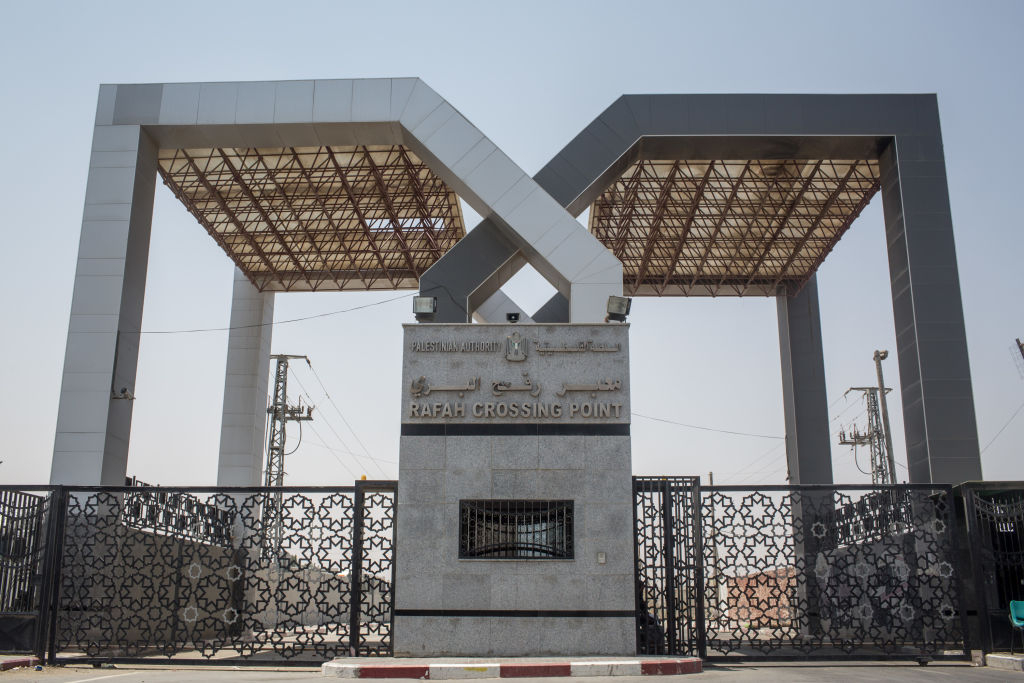
In 2017, the Rafah border crossing between Egypt and the Gaza Strip was open altogether for less than 30 days; by contrast, the border between Israel and the Gaza Strip was open for more than 280 days during the same year.
Israel enforces a naval blockade on the Gaza Strip that is meant to prevent Iran, Hezbollah and other terror parties from smuggling weapons into the coastal enclave controlled by Hamas. At the same time, Israel has kept its border crossings with Gaza for the movement of goods and individuals.
Israel permits Palestinians to enter and leave the Gaza Strip through the Erez border crossing. Last month, the Palestinian Authority Prime Minister entered the Gaza Strip through the Erez border crossing, only to have his convoy targeted by a roadside bomb once inside Hamas-controlled Gaza. Israel also allows foreigners to enter the Gaza Strip through the same border crossing. They include journalists, diplomats, and hundreds of foreigners working for various international aid agencies, including the United Nations.
All this while the Rafah border crossing with Egypt remains closed. Since the beginning of this year, the Egyptians opened the border crossing intermittently only for two or three days each time. Egypt also continues to bar foreigners from entering the Gaza Strip through the Rafah terminal. Even Arabs who want to help the people of the Gaza Strip are forced to enter through the Erez border crossing because the Egyptians do not give them permission to use the Rafah terminal.
In 2017, Egypt opened its Rafah border crossing with the Gaza Strip (pictured above) for less than 30 days altogether; by contrast, the border between Israel and the Gaza Strip was open for more than 280 days during the same year. (Photo by Chris McGrath/Getty Images)
Take, for example, the Qatari envoy to the Gaza Strip, Ambassador Mohammed Al Emadi. Each time he leaves and enters the Gaza Strip, he uses the Erez border crossing with Israel. The Egyptians will not allow him or any other Arab seeking to help the Palestinians in the Gaza Strip to enter through the Rafah terminal.
Given this reality, the question is: Why aren't the Palestinian protests directed against Egypt? The answer is obvious.
The Palestinians know that messing with the Egyptian army will cost them a heavy price. If Israel used snipers to stop the March 30 protesters from crossing the border, the Egyptian response would undoubtedly have been much tougher. The Egyptians would have used artillery and warplanes against the Palestinian demonstrators. The Palestinians are well aware that the Egyptian army would raze the entire Gaza Strip if the Palestinians breached the border and undermined Egypt's national security.
Besides, the "March of Return" is intended as part of the Palestinian national struggle against the "Zionist entity" -- Israel -- and has nothing to do with the closure of any border.
It is part of the Palestinian jihad (holy war) to eliminate Israel, which they see as a "colonialist project" imposed on the Arabs by Western powers after World War II. Palestinian Authority President Mahmoud Abbas, in a rare moment of honesty, admittedearlier this year that this is precisely how Palestinians and Arabs perceive Israel.
The organizers of the "March of Return" have made it clear that besides flooding Israel with millions of Palestinian "refugees," the campaign has two other objectives: to foil Trump's "deal of the century" and stop any form of Arab normalization with Israel.
The Palestinians have proclaimed a wholesale rejection of Trump's plan because they know it will not advance their goal of turning Jews into a minority in their own country. Trump's plan, they believe, does not recognize the Palestinian "right of return," which means that "refugees" and their descendants will not be allowed to move into Israel, turning it into an Arab-majority state.
The organizers of the "March of Return" have clearly stated that this is a driving force behind the mass protests -- to send a message to the Trump administration that Palestinians will not accept any deal that does not facilitate their dream of replacing Israel with an Arab Islamic state.
The "March of Return" is also aimed at sending a warning to the Palestinian Authority and the Arab countries not to make any concessions to Israel or collaborate with the Trump administration.
Again, this is not what political analysts are saying. Instead, these are the exact words and phrases used by the organizers of the event. Their ultimate goal: to prevent Mahmoud Abbas and his Palestinian Authority from returning to the negotiating table with Israel and to threaten Arab countries not to sign peace agreements with Israel.
Now, the organizers are telling us that the "March of Return" will continue and reach its peak in mid-May, on the 70th anniversary of the establishment of Israel.
The "March of Return" is yet another phase in the Palestinian attempt to wipe out the presence of Israel in the Middle East, not about any blockade. The "March of Return" is an anti-peace campaign designed to thwart any attempt to achieve peace between Israel and the Arab countries.
The leaders of Hamas, Islamic Jihad and the other groups that organized the mass protests are now complaining about the high death toll and accusing Israel of opening fire at "unarmed and peaceful" protesters. These are the same leaders who urged their people to head to the border with Israel and to try to force their way into Israel. These are the same leaders who encouraged their people to damage the security fence along the border with Israel. Did they expect the Israeli soldiers to greet them with flowers?
As for Mahmoud Abbas, he has supplied yet more proof of his towering hypocrisy. Hours after the violent confrontations along the border between the Gaza Strip and Israel, Abbas appeared on Palestine TV to hold Israel "fully responsible" for the violence and death and injury of the protesters.
This is the same Abbas who recently told us that Hamas was a terror group that was behind the March 13 botched assassination attempt on his prime minister. This is the same Abbas who last year imposed sanctions on the Gaza Strip by suspending payments for electricity supplied to the Gaza Strip by Israel and suspending payments to thousands of civil servants there. Instead of condemning Hamas for sending the Palestinians to clash with the Israeli army and endanger their lives, Abbas chose to denounce Israel for protecting its border.
The Palestinian "March of Return" is being mistakenly referred to by some journalists and political analysts as a "peaceful and popular" drive by Palestinians demanding freedom and better living conditions.
Palestinians' living conditions in the Gaza Strip could be improved if the Egyptians only opened the Rafah border crossing and allowed Palestinians to leave and allowed Arabs and others to come and help the people there. Their lives could be improved if Hamas stopped building terror tunnels and smuggling weapons.
But, as has become evident by now, the "March of Return" is nothing but a declaration of war on Israel and the Trump administration.
Bassam Tawil is a Muslim based in the Middle East.
My son is 4.5 now. It’s a delightful age when he is still full of sometimes grammatically incorrect sentences that give us a glimpse into the magical and unique way that toddlers see the world. In everything, my husband and I look for teaching moments. Our policy is to tell the truth, even if we need to simplify it a little bit.
Like most first generation Americans, he hears the words “when I was little…” from us a lot. It’s followed by a comparison of how different his American childhood is from our Soviet childhoods: everything from toys and food, to freedom of religion and celebrating diversity.
Last week, we went to our local Chabad for a model matzah baking. At the end, the kids received real shmurah matzah, and the Rabbi even mentioned to us that it comes from Dnepropetrovsk. (When I was little, there were no matzah bakeries in Dnepropetrovsk.) That morning, as I was getting my tortilla out of the fridge, I mentioned to Will that, once Pesach starts, I won’t be eating any tortillas and we giggled about the difficulty of spreading peanut butter and jelly on matzah without breaking it. And then, somewhat thoughtfully, Will remarked: “You’ll probably be really sick of matzah by the end of Pesach! Aaaaaand, you can’t have pancakes!” Even though I was already risking being late for work, I decided that the moment was right to share my thoughts on Pesach with my son since he had brought it up.
“You know what? You’re right, by the end, I do miss real bread. But you know what else? I’m really happy when I eat matzah. It reminds me that I’m free to eat it and free to celebrate Pesach. Did you know that when I was little, we weren’t allowed to?” Aha! I saw the spark of interest in his eyes! My cue to continue: “When I was little, and even when Grandma Yana was little, we weren’t allowed to celebrate Pesach and eat matzah. In the Soviet Union, the government didn’t want Jews to celebrate their holidays. We couldn’t go to the library and learn to make matzah. And Jews couldn’t even speak Yiddish in public! Can you imagine what it would be like if you were only allowed to speak Russian at home and never, ever outside?!”
Confused surprise flashed across my son’s face. “Is that why everyone only remembers some words in Yiddish but not all?” he asked. “And is that why you want me to speak Russian? So I don’t forget it like they forgot Yiddish?” Bingo! A connection has been made! It was imperfect, but I’ll take it!
I came back to eating matzah. Yes, I miss hametz by about Day 5. But the truth is, Pesach is one of my favorite holidays precisely because it celebrates freedom. Freedom of my Jewish people from slavery, freedom of refugees/Americans-by-choice like us to be Jewish, and most recently, freedom of self-determination for Jews in Ukraine, who joined Ukrainians of all backgrounds to proclaim that they too want to live free of corruption and outside political influence.
My son is that new generation that will not know political oppression and religious suppression. He is that pure generation that hears about things so unthinkable to him that he probably assumes we exaggerate. Watching him grow up free and teaching him what it means to be Jewish is an honor and a joy. It is something I do openly, buying Jewish books in Barnes & Noble and celebrating holidays in public spaces. These are such simple things, yet so unthinkable for my parents and grandparents. They managed to pass on what little they knew out of sight and with some apprehension. I eat matzah for them, to be reminded that Jewish freedom comes with a heavy price. But in 2015 America, passing on the significance of that freedom is both my luxury and my responsibility.




 My son is 4.5 now. It’s a delightful age when he is still full of sometimes grammatically incorrect sentences that give us a glimpse into the magical and unique way that toddlers see the world. In everything, my husband and I look for teaching moments. Our policy is to tell the truth, even if we need to simplify it a little bit.