Search This Blog

Saturday, 21 July 2018

Austrian Police Investigating ‘Antisemitic’ Assailant in Violent Rampage in Vienna Jewish District

avatarby Ben Cohen


Amateur video captured police officers in Vienna arresting assailant Burkay S. Image via oe24.at
A young Jewish man who was violently assaulted on a busy street in Vienna on Thursday has spoken to Austrian media about the ordeal, stressing the antisemitic nature of the attacks on himself and other Jews walking in the same area by a man who shouted angrily in German and Arabic.
In an interview with broadcaster OE24 on Friday, the victim, named as Daniel S., said that he had just left the synagogue on Tabostrasse — a thoroughfare in a district in which many of Vienna’s Jews live and work — “when I felt a firm kick from the back of my hip.”
Daniel said he spun around to confront a man who looked at him “with real hatred.”
Asked whether the attack was antisemitic, Daniel said that he had been assaulted immediately after the attacker — identified as Burkay S., an unemployed 24-year-old — had punched and kicked three Jews outside a kosher restaurant in the same street. He said that a friend had then witnessed the assailant “cross Taborstrasse and walk right up to me.”
JULY 20, 2018 4:51 PM
0
“We were all recognizable as Jews,” Daniel said. “I wore a kippah and my tzitzit and I was carrying a tefillin bag. The other Jews also wore kippot.”
The assailant’s violent rampage had begun an hour earlier, when he punched and kicked a 37-year-old Jewish woman walking in a nearby street.
Following the attack on the Jewish men outside the restaurant, police captured the assailant at a local subway station. Eyewitness Benjamin Gilkarov told OE24 that Burkay S. “seemed mentally ill, but he attacked the three men very purposefully.” One victim was felled by what Gilkarov described as “a karate attack with both legs in the back.”
Alexander Marakovits, a spokesperson for the Austrian Interior Ministry, confirmed on Friday that Burkay S. would remain in police custody — a measure permitted under Austrian law if the offender is deemed to represent a continuing risk.
Quoted by the Kronen Zeitung news outlet, Marakovits said the decision was made after police discovered that Burkay S. had committed similar violent assaults in the same area on Wednesday.
Austrian Chancellor Sebastian Kurz meanwhile promised a full investigation into whether the attacks were antisemitic.
“We are resolutely fighting any form of antisemitism,” Kurz said on Friday. Austria’s government “will do everything to ensure that Jewish life in Austria is safe,” he added.

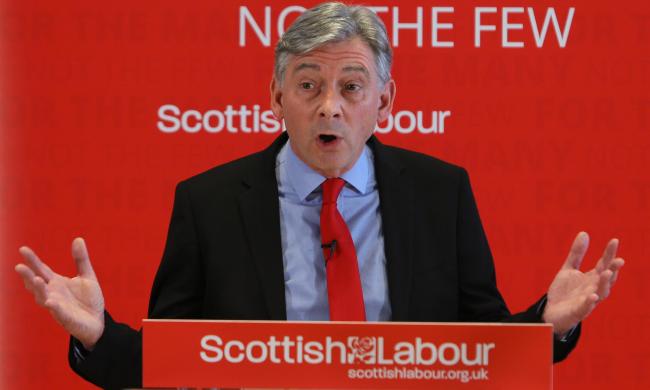
Scottish Labour urged to adopt anti-Semitism definition in full


Richard Leonard's party are under pressure to accept the International Holocaust Remembrance Alliances' definition


Members in East Renfrewshire have written to the Scottish Executive Committee asking them to break with colleagues and “implement the full and unamended [International Holocaust Remembrance Alliance] definition of anti-Semitism.”
On Tuesday, the NEC, Labour’s ruling body, ignored the pleas of Britain’s chief rabbi, Ephraim Mirvis and 65 other senior clerics, and decided to use their own definition of anti-Semitism in a new code of conduct being drawn up.
That code will take some but not all of the IHRA’s well established definition. Controversially the party code says “contentious” remarks about Israel will “not be treated as anti-Semitism unless accompanied by specific anti-Semitic content”.
In his letter, Ben Proctor, the chair of the constituency Labour party in East Renfrewshire, said his party “no longer wish to listen to those who understand anti-semitism best – the Jewish community.”
He added:“While there is inaction on a UK level, we in Scotland have a duty to act.”
A Scottish Labour Party spokesman pointed out that the NEC had also “agreed to re-open the development of the code, in consultation with Jewish community organisations and groups”.

Labour MPs and peers plan to defy Corbyn on antisemitism definition


Members to vote on changing code of conduct agreed by national executive committee
Labour MP Luciana Berger speaks during a protest against antisemitism in the Labour party in Parliament Square, London, in March.
 Labour MP Luciana Berger speaks during a protest against antisemitism in the Labour party in Westminster in March. Photograph: Yui Mok/PA

Labour MPs and peers are planning an extraordinary joint act of defiance against Jeremy Corbyn and the party’s ruling national executive committee (NEC) that would see them incorporate the full internationally accepted definition of antisemitism into their own official rulebooks, putting them directly at odds with the party leadership.
The moves by Labour members of both Houses of Parliament look set to fuel an already explosive row that erupted last week, after the NEC refused to ditch a controversial new code of conduct on antisemitism that many MPs and peers say does not go far enough.
In the hope of forcing the NEC and party leadership into a U-turn, Labour MPs will on Monday push an emergency motion at a meeting of the parliamentary Labour party that would, if passed, amend its rulebook to include an obligation on members “to accept and abide by the full International Holocaust Remembrance Alliance working definition of antisemitism, including all of its accompanying examples”.
Separately, the Observer has learned that Labour members of the House of Lords will be asked to vote when parliament returns in September on a motion to alter the Labour peers group handbook so that it also includes reference to the need for members to abide by the full IHRA definition.
In an email, the chair of Labour members of the House of Lords, Toby Harris, said he was sure colleagues would share his “deep concern at the Labour party’s failure fully to adopt the International Holocaust Remembrance Alliance definition of antisemitism”.
He said that “following consultation with the Labour Lords leadership … I will be proposing from the chair that we adopt the IHRA definition and its associated examples – unamended – into our rules [the Labour peers group handbook]”.


The new party code of conduct has been widely criticised because it fails to incorporate all the examples of what constitutes antisemitism that are listed alongside the IHRA definition.
The examples omitted from the new Labour code agreed by the NEC include accusing Jewish citizens of being more loyal to Israel than their own nations, claiming that the existence of the state of Israel is a racist endeavour and comparing Israeli actions with those of the Nazis.
The decision by the NEC last Wednesday to adopt the new code came despite complaints and warnings from members of the parliamentary Labour party and Jewish organisations urging the ruling body to include the full list of examples.
The emergency motion to be submitted to the PLP has been tabled by the Jewish Labour MPs Louise Ellman and Ruth Smeeth. They are backed by another Jewish member, Luciana Berger. Berger, parliamentary chair of the Jewish Labour movement, said she expected the motion would be accepted for debate and voted upon when time allowed. “Its purpose is to demonstrate the strength of feeling in the parliamentary party. It is unfathomable that we find ourselves in this position as a party,” she said.
After the NEC decision, Labour minister and ex-chair of the public accounts committee Margaret Hodge confronted Corbyn in the House of Commons and accused him of being “an antisemitic racist”. She is now the subject of a party investigation.

Labour leader Jeremy Corbyn has been criticised for not rooting out antisemitism in the party.
Pinterest
 Labour leader Jeremy Corbyn has been criticised for not rooting out antisemitism in the party. Photograph: David Hartley/Rex

A Labour party spokesperson said that while the code had been adopted, it would be subject to further discussion in the light of strong feelings expressed: “The NEC upheld the adoption of the code of conduct on antisemitism but, in recognition of the serious concerns expressed, agreed to reopen the development of the code, in consultation with Jewish community organisations and groups, in order to better reflect their views.”
On Saturday night the Labour MP Wes Streeting said he believed the NEC had taken the approach it had so that it would be easier for the party to reject complaints made against members over antisemitism.
“It is hard to draw any other conclusion than that this is intended to make it easier to let more people off the hook, whether they be new members of the party or senior figures within it.”
On Saturday, in an interview with the GuardianEddie Izzard urged Corbyn to deal promptly with the issue. The comedian, who recently won a seat on the NEC, said Labour risked not being ready to attack the government and its Brexit plans because of infighting over antisemitism.
“We shouldn’t be getting caught in this antisemitic definition row,” Izzard said. “If there is ever a time to adopt the full IHRA definition and be in step with the Jewish community, the rabbis, go with the mainstream, rather than say we wish to adjust, that meeting was the time. And we didn’t.”
He said Labour had agreed to reopen discussions with Jewish groups, but that he regretted that a new code of conduct had been approved despite warnings from Jewish groups about the omission of some of the working examples from the IHRA.


Turkish refugees: “Our body is here, but our soul is there”


Handan

Jul 18 2018

Turkish refugees: “Our body is here, but our soul is there”

Political upheaval in Turkey and fighting in the country’s Kurdish majority Southeast region have led to a surge in job dismissals, detainments, and court cases, leaving many to flee the country.
These conditions don’t leave much of a future in Turkey for many. Some are leaving Turkey after receiving lengthy prison sentences, and others are leaving out of concern that they could be arrested.
The two women who spoke with Ahval News went to Europe as refugees, and they are just two of dozens of other women who have felt forced to leave the country. While they have different stories, many share two commonalities: love of their country but a pressure to leave Turkey due to a lack of justice.
One reason for this is the number of presidential decrees issued by President Recep Tayyıp Erdoğan since the foiled military putsch in July 2016. These decrees have called for the sacking of civil servants including police, army officers, academics, and teachers. According to the Stockholm Center for Freedom, more than 160,000 civil servants have been dismissed as a result of these decrees since July 2016.
Mine Çetinkaya was one of those dismissed in 2017. She spent twenty years working as a teacher in Turkey as part of the Ministry of Education. She was also a member of Eğitim-Sen (Education and Science Workers’ Union), a left-wing trade union of educators.
Her story started when she was arrested as part of a broader investigation in 2009. When asked why a lawsuit was opened against her, she said, “I was arrested because of my involvement in the union. They established [terrorist] organization connections by construing it with my involvement in the union,” she said.
She served a nine-month prison sentence, but her case was still ongoing. Çetinkaya was then sentenced to an extra six years in prison when the case was concluded. Upon learning this, she fled.
Mine Çetinkaya
"I first thought that I would serve the six-year sentence. Then, there was another case opened about an anti-war protest I participated in as an observer. I was torn. There was a good chance that I would go to prison and not leave. It appeared to be six years, but this number would have gone up [while being] inside.”
Sixty-year-old Zarife Atık was involved in local politics and also left Turkey to avoid detention. She had been a provincial co-chair during the June 7, 2015 general elections for the pro-Kurdish People's Democratic Party (HDP), and she was also a member of the HDP party parliament.  
Atık also had lawsuits filed against her in Turkey. She went to Holland for a holiday four months ago and decided not to go back to Turkey over concerns of being detained and the pressure put on the opposition in recent years. The lawsuits were not her first run-in with the law in Turkey. Atık had already been to prison for ten months after protesting the military coup in 1980.
Zarife
When asked about the political climate in Turkey in recent years, Atık said that the collapse of the Peace Process as a major a blow to Turkey’s democracy. The Peace Process was a ceasefire to end the two-decades-long struggle between the government and the separatist Kurdistan Workers’ Party. However, the peace agreement broke down in the summer of 2015.
"People were in need of reconciliation in Turkey. It was a process that everyone enjoyed. Those in political power buried it. Turkey's democracy started dying in the November 1 [2015] elections."
Although she lives abroad, Atık says that she continues to closely follow developments in Turkey and commented, “There are thousands like me. There is nothing going forward. Still, I’ll continue to be the opposition.”
Atık criticized President Erdoğan and highlighted that the recent change from a parliamentary system to a presidential system of government shows the lack of independence within the government.
"Turkey has become a one-man regime. The one guy designs everything about the regime with presidential decrees. There is no parliament in Turkey as Erdoğan has assembled the parliament himself. Turkey is going through a dark and difficult period."
The journey to Europe can be a perilous one for some.
Because the government banned her from leaving the country, Çetinkaya first illegally crossed into Greece and then went onto Switzerland. She stayed in poor conditions at a refugee camp for seven months in Switzerland before being able to move into a house. Çetinkaya considers herself lucky.
“Because there are some people who stay in the camps for two or three years. I'm better now. But I don't have a house of my own. I don't have the right to work. I'm just learning the language.”
Although her living situation improved, Çetinkaya isn’t happy in Switzerland and said, “I had a profession in Turkey. I had a job. I had to come here with a backpack. My whole life was left behind.”
Atik echoed a similar sentiment. Her daughters and husband are in Turkey. She says that after a certain age, it's difficult to leave your loved ones behind for life in another country.
"There’s nothing as bad as being stuck in one place. Your life is restricted. You condemned yourself to something else. You try to familiarize yourself with the feeling of staying here. This is not something to get used to. Our body is here, but our soul is there."
She continued by saying, "I am speaking in pain. Staying here is a very painful thing. But this is a process, and that's how it goes."

Turkey dispatches economic attaché to Israel


Jul 14 2018

Turkey dispatches economic attaché to Israel

Turkey has sent a commercial attaché to its embassy in Tel Aviv in an effort to bolster trade relations with Israel, Arab News reported on its website on Friday.
The move comes despite continuing political tensions between the two countries over a range of issues including growing Turkish influence in Jerusalem and the plight of the Palestinian people.
Seli Nasi, an expert of Turkish-Israeli relations, described the appointment as positive, but added, “It is too early to say whether it will lead to a political reconciliation. The conflicts that prompted Turkey’s downgrading of diplomatic ties still remain.”
The appointment of an economic attaché also brings into focus conflicting trends in the relationship between the two countries said Gallia Lindenstrauss, a research fellow at the Tel Aviv based Institute for National Security Studies.
“On the one hand, the states seem to be on a collision course over Jerusalem and Gaza. On the other, there are still economic benefits from maintaining relations and even trying to improve the trade volume,” Lindenstrauss said.
Lindenstrauss added that the Turkish embassy in Tel Aviv had been understaffed for years after long-running disagreements between Israel and Turkey. Turkey recalled its ambassador to Israel earlier this year after 60 Palestinians were killed in clashes along the Gaza border, with Israel’s ambassador also returning from Ankara.
Nasi suggested that if Turkey’s appointment of an economic attaché to Israel is not followed by the return of ambassadors to their posts, it will indicate that economic cooperation will constitute the backbone of future relations between the countries.
Nasi also indicated that the move can be seen in the broader context of US-Turkish relations, saying, “At a time when Turkey and the US have been moving to repair ties, Turkey’s move can be read as a gesture of goodwill toward Washington.”