I am not an historian, decent author or a journalist, and the chances are that unless there is a link or reference to somewhere else, the perpetrator is yours truly – Renaud Sarda. I created this blog as a focal point, to arm people with arguments and facts that they can perhaps use to counter biased media reporting and anti-Israel propaganda, and to help counter (BDS) campaign. I am a Zionist/Sephardi/Jew who will fly the Israeli flag, and defend whatever Israel does.
It would appear unwise for Israel (or any country for that matter) to insert itself into additional intractable conflicts, so when Haaretzreported that a plane from Azerbaijan’s defense ministry landed in Israel twice during four days of clashes in the self-declared and largely unrecognized republic of Ngorno-Karabakh last month, it raised some eyebrows. But Israel’s slight embroilment in a severe greater-European security emergency doesn’t necessarily amount to foreign policy recklessness. If anything, it’s a sign of Israel’s surprising freedom of action at the moment—a time when the country’s foreign policy is in a more commanding position than it might appear.
Ngorno-Karabakh is a majority-Armenian region, and current Armenian-controlled separatist enclave, that remained within Azerbaijian’s territory after the former Soviet Republics became independent in 1991, sparking a war that killed as many as 30,000 people. A 1994 ceasefire left some 16% of Azerbaijan’s internationally recognized territory under Armenian control. There’s been little real progress towards peace since then.
Armenia is closely allied with Russia and Iran, while Azerbaijan is a Turkic-speaking country with cultural, historical, and political ties to Ankara. Russia and Turkey don’t quite get along these days, and a renewed war in Ngorono-Karabakh—at worst, a full-blown Russo-Turkic proxy conflict in the central Caucasus—belongs on the short-list of plausible geopolitical nightmare scenarios. This month’s fighting was especially awkward for Israel: Thanks to their close defense relationship and shared antipathy towards an Iranian regime ensconced directly to the country’s south, Azerbaijan is one of Israel’s closest majority-Muslim allies.
The Ngarno-Karabakh fighting—Haaretz reported that 112 people have thus far died due to the conflict there—and Israel’s apparent bit role in the outburst, did not come at convenient time for Israel’s foreign policy. Russia and Israel are just one mid-aircollision over Syria away from a diplomatic crisis while a “deconfliction” agreement between the countries has likely preserved Israel’s ability to go after Hezbollah targets in the country. Israel and Russia are effectively on opposite sides of the Ngorno-Karabakh conflict: a modest Russian deployment in Armenia acts as a deterrent on an Azeri military strike to reclaim the territory, while Israel is Azerbaijan’s only supplier of advanced weaponry, according to a 2015 paper by the Israel-based Institute for National Security Studies’ Gallia Lindenstrauss. As Lindenstrauss notes, the Organization for Security and Cooperation in Europe maintains an “embargo on arms sales to Azerbaijan and Armenia, at the declarative level at least.” Israel considers its relationship with Azerbaijan to be more important than any nonbinding OSCE directive: According to Haaretz, Israel has soldAzerbaijan some $5 billion in weaponry over the past four years.
Notably, Israel has helped Azerbaijan keep its military options open—without going gone quite as far as it could in backing Baku’s position in the Ngarno-Karabakh conflict. As retired IDF general Efraim Sneh observed in an April 15 piece in Al Monitor, Israel hasn’t called for an Armenian withdrawal from Azberbaijan’s territory and has done little to back its ally in the diplomatic sphere in the wake of the flare-up. Sneh attributes this to similarities between Armenian occupation ofAzerbaijan’s land and Israel’s occupation of the West Bank: In calling for a military withdrawal in what Sneh believes to be an analogous situation, Israel would only draw attention to its own failure to remove its troops from land that doesn’t belong to it.
There are other possible explanations: Israel might think that the status of Ngorno-Karabakh is a matter better left for Armenia and Azerbaijan to determine. And while it’s one thing to provide military assistance—which remains largely hidden from public view, save for the occasional Haaretz article—a diplomatic spat with a Russian ally would be a more public and potentially messier affair.
There’s perhaps an even more straightforward explanation for Israel’s seemingly hazardous and self-contradictory stance in the conflict. For the time being, Israel enjoys remarkable and perhaps unprecedented strategic depth in its region. Israel has competently navigated a Syrian civil war that has flummoxed or destabilized every neighboring country. The various Palestinian factions are weak and divided. Israel’s in the process of normalizing relations with Turkey. Even Saudi Arabia is now essentially guaranteeing the country’s access to the Red Sea and the Indian Ocean.
There are looming threats to Israel’s strategic depth—Iran and various United Nations Security Council resolutions among them. But for now, Israel is in a strong enough position to forge a relationship with a country like Azerbaijan on its own terms—and regardless of the potential consequences.
Armin Rosen is a New York-based writer. He has written for The Atlantic, City Journal, andWorld Affairs Journal, and was recently a senior reporter for Business Insider.
Befitting his “revolutionary” campaign, Sen. Bernie Sanders uttered something revolutionary at the Brooklyn Democratic presidential debate before his loss in the New York primary last week: He spoke up on behalf of the Palestinian people.
“As somebody who is 100 percent pro-Israel,” the Vermont socialist averred, “we are going to have to treat the Palestinian people with respect and dignity.” Sanders added that Israel’s response to Hamas rocket attacks in 2014 was “disproportionate,” that “we are going to have to say that [Israeli Prime Minister Benjamin] Netanyahu is not right all of the time,” and took a swipe at his rival, former Secretary of State Hillary Clinton, scolding her for having “barely mentioned the Palestinians” in a speech to the American Israel Public Affairs Committee (AIPAC).
Within seconds, hosannas from the herd of independent minds poured forth. “Historic” declaredThe Huffington Post. “Bernie Sanders just shattered an American taboo on Israel,” gushedVox’s Zack Beauchamp, whose knowledge of the Middle East is so voluminous as to include the imaginative, like the “bridge” connectingGaza to the West Bank (which, naturally, Israel “limits traffic on.”) “Bravo to Sanders for saying that Israel’s assault on Gaza was disproportionate!” exclaimed Nicholas Kristof of the New York Times. “Truth in a campaign! Wonders never cease!”
In reality, standing up for “Palestinians’ humanity,” as Beauchamp wrote, is as much a “taboo” as being in favor of healthy school lunches or cleaner air and water. To think otherwise, one would have to inhabit a world where ABC, CBS, NBC, NPR, theWashington Post, the New York Times, the BBC, The Guardian, every major European broadcast network and newspaper, Vox, Salon, Slate, American academia, the United Nations, Amnesty International, Human Rights Watch, Oxfam, and countless other media outlets and international institutions don’t exist. George W. Bush, remember, was the first American president to call for the creation of a Palestinian state.
But to a particular type of commentator, and a particular type of Jew, the relevance of Sanders’ remarks lay not in what he said. Rather, it is the act of virtue-signaling—only we, the righteous Jews, as opposed to those cold-hearted tribalists, appreciate another people’s suffering—that sends the proverbial thrill down the leg. Expressing approval for Sanders’ supposedly heretical pabulum is simply an easy way to distinguish oneself from one’s supposedly less sophisticated co-religionists.
While Sanders’ even-handedness on the Israeli-Palestinian conflict is utterly banal, there is one sense in which his campaign is genuinely historic: He is the most successful Jewish presidential candidate in American history. But unlike Joe Lieberman, who was the first Jew to appear on a major party ticket in 2000, Jewishness—religious, cultural, political—is not something that Sanders likes to discuss. More often than not, it has been a source of awkward embarrassment, which he often tries to avoid by identifying himself as “Polish.” In an interview last June, NPR’s Diane Rehm asked Sanders to address his “dual citizenship with Israel.” When Sanders informed Rehm that he is “an American citizen, period,” the host protested that his name appeared on a “list” of American-Israeli dual nationals. (Rehm later apologized, though why she and her producer accepted as fact the assertions of neo-Nazis on the Internet has not been sufficiently explained.)
Earlier this month, anti-Semitism again reared its ugly head in the form of a questioner who confronted Sanders at the Apollo Theater in Harlem. “As you know,” the man asked, “the Zionist Jews—and I don’t mean to offend anybody—they run the Federal Reserve, they run Wall Street, they run every campaign.” Struggling to finish over the audience’s loud booing (the only hopeful sign in an otherwise dispiriting moment of an already dispiriting campaign season), the man asked, “What is your affiliation to your Jewish community? That’s all I’m asking.”
As my Tablet magazine colleague Yair Rosenberg noted, Sanders’ answer was disappointing. Rather than use the outburst as an opportunity to rebuke blatant bigotry and leave it at that, Sanders thought it necessary to express his pro-Palestinian bona fides—so, you know, no one might think he was that kind of Jew. “Talking about Zionism and Israel,” Sanders said, “I am a strong defender of Israel, but I also believe that we have got to pay attention to the needs of the Palestinian people.” Of course, the questioner was not talking about the subtleties of the Middle East conflict when he alleged that “Zionist Jews” control everything from the nation’s money supply to its political system. His use of “Zionist,” as is so often the case when anti-Semites wish to disguise their anti-Semitism, was plainly conspiratorial.
Bernie Sanders’ campaign has illuminated the new rules that govern Jewish participation on the progressive left. One cannot simply be a Jew: One must be a Jew who loudly and proudly declaims his distance from Israel and the American Jewish “establishment” at every possible opportunity. And unlike every other member of the progressive coalition, Judaism and Jewish peoplehood must only be expressed through a universalist vision of “social justice” that emphatically proclaims that Jewish causes and rights are no more (or usually less) worthy than those of Black Lives Matter, the Palestinians, La Raza, etc., and which sees this self-abnegation as the price of entry—for Jews alone.
Bernie Sanders’ campaign has illuminated the new rules that govern Jewish participation on the progressive left. One cannot simply be a Jew: One must be a Jew who loudly and proudly declaims his distance from Israel and the American Jewish “establishment” at every possible opportunity.
The Sanders campaign is important as a space in which the left’s universalistic pretensions are coming into conflict with the particularistic concerns of Jewish nationalism—as many on the left single out Israel for opprobrium and demand that their Jewish comrades do the same. English novelist Howard Jacobson ridiculed “ ‘As a Jew’ Jews” as those who invoke their ethnic identity solely to criticize Israel and their ethno-religious brethren. It is a species hardly unique to the Jewish tribe, but one that is certainly louder—and the recipient of more disproportionate and fawning media coverage—than any other genus of self-styled ethnic dissenter, a type that when found in other communities is generally ridiculed as an Uncle Tom or a puppet of the patriarchy.
Sanders’ snub of the bipartisan AIPAC conference (he was the only presidential candidate not to address its nearly 20,000 members) was a defining mark of this tendency. So too was its hiring of a Jewish outreach director, Simone Zimmerman, whose key qualification for the job of liaising with American Jewry was antagonizing her fellow Jews. When it was revealed that Zimmerman had attacked Clinton’s AIPAC speech as “racist and orientalist,” called on Hillel to provide a platform for anti-Zionists and other supporters of the Boycott, Divestment and Sanctions movement against Israel, and authored an expletive-laden Facebook tirade condemning Netanyahu as an “asshole” who had “sanctioned the murder of over 2,000 people,” the Sanders campaign suspended her. Rushing to Zimmerman’s defense was the chameleon-like Peter Beinart (Rhodes Scholar, Marshall “declined”), who, having grown tired of being a leading liberal hawk shape-shifted into a left-wing critic of American imperial hubris, now bears the burden of being the self-appointed conscience of American Jewry. He told the Times that Zimmerman’s suspension amounted to “the American Jewish community eating its own”; Beinart elaborated that, “She cares deeply and wants to make [the Jewish community] live up to its own stated ideals.” If only American Jews were as conscientious and caring as Peter Beinart and Simone Zimmerman.
A more revealing aspect of the Sanders phenomenon concerned his notorious interview with the Daily News editorial board, in which he incorrectly asserted that 10,000 civilians had been killed in the 2014 Gaza War. After Sanders consulted with the Anti-Defamation League, his campaign revised the number down to the United Nations estimate of some 1,500 civilians (Israel maintains the number of innocents killed is substantially lower). The questioning of casualty figures, however, is beside the point, because to Sanders and his supporters, the number doesn’t matter. Even five hundred or one hundred Palestinians killed by Israel in Gaza—in the midst of a racist war started by a genocidal terrorist organization—would have been “disproportionate.”
Which in turn brings up a very important point: If the numbers are irrelevant, and the need for moral outrage is not based on the quantity of the dead, then what is it based on, exactly? Why are Bernie Sanders and his Jewish surrogates not permanently outraged by the nearly half a million dead civilians in Syria? The answer, apparently, is that there exists a special kind of math in which even one dead Palestinian—killed unintentionally by Israeli forces in the midst of an ethically justified, defensive war provoked by its adversary—is proof of some horrible moral outrage committed not by the Palestinians but by Israel. Meanwhile, these selfsame critics have little or nothing to say about the incessant American drone strikes, dramatically intensified by a president they idolize, which have killed far more innocent people than the Israeli Defense Forces, never mind the atrocities committed by Russia, China, Iran, Syria, Egypt, and practically every other country on the planet.
Last month, the Village Voice published a cover story titled, “The Heresy and Evangelism of Bernie Sanders,” which explicitly put forth the sociologically accurate if hardly morally binding proposition that, to be good leftists, Jews must denounce Israel. The article’s author, Jesse Alexander Myerson, correctly complained about a dichotomy of “good and bad Jews” that, for centuries, was inflicted upon Jews by the governments under which they lived. In the 20th century, “bad Jews” were socialists, who carried the virus of Bolshevism with them wherever they traveled. “Good Jews” were Zionists, directing their utopian desires abroad, to Palestine, and later, Israel. Over time, Myerson argues, Jews themselves began to internalize this form of discrimination, casting out of their own community those Jews who opposed Zionism. “The internationalism of the prewar American Jewry was supplanted by nationalism,” he writes with dismay. “Our egalitarian commitment was replaced by exceptionalism. Our agitation against war was undermined by ceaseless colonialism in Palestine. Jews have been instructed that the cluster bombs and night patrols blanketing the Holy Land are necessary to preserve our heritage.”
To combat this unfair, externally imposed fissure, Myerson essentially argues for adopting its opposite: that is, Jews should embrace socialism and reject Zionism. And in Sanders, Myerson sees a candidate who, whatever his perfunctory endorsements of Israel’s right of self-defense, is an avatar of a new, post-Zionist Jewish identity. Myerson’s argument lacks any nuance, ignoring entirely the left-wing Zionist tradition that founded the state of Israel and exists to this day. Yet what’s most revealing about Myerson’s article is that only Jews are expected to give up their particularist concerns. Myerson would never contemplate asking Black Lives Matter activists to shut up and stop complaining about police brutality, or gays to stop whining about religious liberty laws. Yet that is essentially what he and other leftists are asking of Jews: put aside your concerns qua Jews, because you are standing in the way of the people’s revolution. Speaking of the enduring need for a Jewish State, drawing attention to anti-Semitic incitement on college campuses—all this is special pleading.
This is not a new phenomenon for Jews on the left, who have always had to balance their commitment to cosmopolitan principles with their communal concerns. But it seems to be the case that the scales are tipping on the side of post-national universalism, and that it is becoming ever more exclusionary of Zionism. For many left-wing Jews, distancing oneself from Israel and the American Jewish majority has become a marker of enlightenment and urbanity not unlike the way German Jews looked down upon shtetl Ostjuden from Poland and Russia. Contemporary Western liberal Jewish criticism of Israel’s “right wing drift” also has an unspoken racial component, as the vast majority of American Jews are of Ashkenazi descent while more than half of Israeli Jews are of Sephardi or Mizrahi lineage. And so the tension that long existed (and to some extent, still exists) between the old, Ashkenazi Israeli elite and the dispossessed Mizrachim is now being grafted onto the American-Israeli relationship—with the “good leftist” in the role of the racist Ashkenazi snobs.
Bernie Sanders and his Jewish devotees can distance themselves from Israel and Zionism all they want. But as has always been the case, it will make no difference to the people they are trying to please, who continue to reduce them to a single factor of their identity which in their minds has attained the totalizing force of an epithet: Jew.
***
Like this article? Sign up for our Daily Digest to get Tablet Magazine’s new content in your inbox each morning.
James Kirchick, a fellow with the Foreign Policy Initiative, is a columnist at Tablet. He is a former writer at large for Radio Free Europe based in Prague and a Robert Bosch Foundation Fellow based in Berlin. His Twitter feed is @jkirchick.
On September 11, 1962, a German scientist vanished. The basic facts were simple: Heinz Krug had been at his office, and he never came home.69 Comments
The only other salient detail known to police in Munich was that Krug commuted to Cairo frequently. He was one of dozens of Nazi rocket experts who had been hired by Egypt to develop advanced weapons for that country.69 Comments
HaBoker, a now defunct Israeli newspaper, surprisingly claimed to have the explanation: The Egyptians kidnapped Krug to prevent him from doing business with Israel.69 Comments
But that somewhat clumsy leak was an attempt by Israel to divert investigators from digging too deeply into the case — not that they ever would have found the 49-year-old scientist.+
We can now report — based on interviews with former Mossad officers and with Israelis who have access to the Mossad’s archived secrets from half a century ago — that Krug was murdered as part of an Israeli espionage plot to intimidate the German scientists working for Egypt.69 Comments
Moreover, the most astounding revelation is the Mossad agent who fired the fatal gunshots: Otto Skorzeny, one of the Israeli spy agency’s most valuable assets, was a former lieutenant colonel in Nazi Germany’s Waffen-SS and one of Adolf Hitler’s personal favorites among the party’s commando leaders. The Führer, in fact, awarded Skorzeny the army’s most prestigious medal, the Knight’s Cross of the Iron Cross, for leading the rescue operation that plucked his friend Benito Mussolini out from the hands of his captors.69 Comments
Getty
His Hero: Skorzeny meets with Hitler in 1943 after leading the daring rescue of the German leader’s friend and ally, Benito Mussolini.
But that was then. By 1962, according to our sources — who spoke only on the promise that they not be identified — Skorzeny had a different employer. The story of how that came to be is one of the most important untold tales in the archives of the Mossad, the agency whose full name, translated from Hebrew, is “The Institute for Intelligence and Special Missions.”
Key to understanding the story is that the Mossad had made stopping German scientists then working on Egypt’s rocket program one of its top priorities. For several months before his death, in fact, Krug, along with other Germans who were working in Egypt’s rocket-building industry, had received threatening messages. When in Germany, they got phone calls in the middle of the night, telling them to quit the Egyptian program. When in Egypt, some were sent letter bombs — and several people were injured by the explosions.+
Krug, as it happens, was near the top of the Mossad’s target list.+
During the war that ended 17 years earlier, Krug was part of a team of superstars at Peenemünde, the military test range on the coast of the Baltic Sea, where top German scientists toiled in the service of Hitler and the Third Reich. The team, led by Wernher von Braun, was proud to have engineered the rockets for the Blitz that nearly defeated England. Its wider ambitions included missiles that could fly a lot farther, with greater accuracy and more destructive power.+
According to Mossad research, a decade after the war ended, von Braun invited Krug and other former colleagues to join him in America. Von Braun, his war record practically expunged, was leading a missile development program for the United States. He even became one of the fathers of the NASA space exploration program. Krug opted for another, seemingly more lucrative option: joining other scientists from the Peenemünde group — led by the German professor Wolfgang Pilz, whom he greatly admired — in Egypt. They would set up a secret strategic missile program for that Arab country.+
In the Israelis’ view, Krug had to know that Israel, the country where so many Holocaust survivors had found refuge, was the intended target of his new masters’ military capabilities. A committed Nazi would see this as an opportunity to continue the ghastly mission of exterminating the Jewish people.69 Comments
The threatening notes and phone calls, however, were driving Krug crazy. He and his colleagues knew that the threats were from Israelis. It was obvious. In 1960, Israeli agents had kidnapped Adolf Eichmann, one of the chief administrators of the Holocaust, in far-off Argentina. The Israelis astonishingly smuggled the Nazi to Jerusalem, where he was put on trial. Eichmann was hanged on May 31, 1962.69 Comments
It was reasonable for Krug to feel that a Mossad noose might be tightening around his neck, too. That was why he summoned help: a Nazi hero who was considered the best of the best in Hitler’s heyday.69 Comments
One of the Mossad’s top priorities was stopping German scientists from working on Egypt’s rocket program.
On the day he vanished, according to our new information from reliable sources, Krug left his office to meet Skorzeny, the man he felt would be his savior.+
Skorzeny, then 54 years old, was quite simply a legend. A dashing, innovative military man who grew up in Austria — famous for a long scar on the left side of his face, the result of his overly exuberant swordplay while fencing as a youth— he rose to the rank of lieutenant colonel in Nazi Germany’s Waffen-SS. Thanks to Skorzeny’s exploits as a guerrilla commander, Hitler recognized that he had a man who would go above and beyond, and stop at nothing, to complete a mission.+
The colonel’s feats during the war inspired Germans and the grudging respect of Germany’s enemies. American and British military intelligence labeled Skorzeny “the most dangerous man in Europe.”+
Krug contacted Skorzeny in the hope that the great hero — then living in Spain — could create a strategy to keep the scientists safe.+
The two men were in Krug’s white Mercedes, driving north out of Munich, and Skorzeny said that as a first step he had arranged for three bodyguards. He said they were in a car directly behind and would accompany them to a safe place in a forest for a chat. Krug was murdered, then and there, without so much as a formal indictment or death sentence. The man who pulled the trigger was none other than the famous Nazi war hero. Israel’s espionage agency had managed to turn Otto Skorzeny into a secret agent for the Jewish state.+
After Krug was shot, the three Israelis poured acid on his body, waited awhile and then buried what was left in a hole they had dug beforehand. They covered the makeshift grave with lime, so that search dogs — and wild animals — would never pick up the scent of human remains.+
Wiki Commons
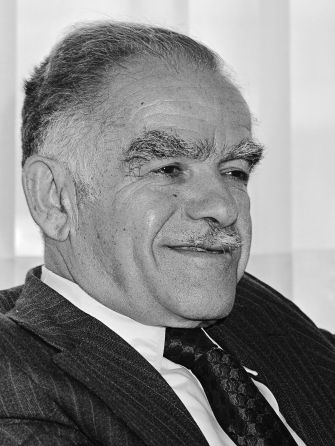
Yitzhak Shamir
The troika that coordinated this extrajudicial execution was led by a future prime minister of Israel, Yitzhak Shamir, who was then head of the Mossad’s special operations unit. One of the others was Zvi “Peter” Malkin, who had tackled Eichmann in Argentina and in later life would enter the art world as a New York-based painter. Supervising from a distance was Yosef “Joe” Raanan, who was the secret agency’s senior officer in Germany. All three had lost large numbers of family members among the 6 million Jews murdered by the cruel, continent-wide genocide that Eichmann had managed.+
Israel’s motivation in working with a man such as Skorzeny was clear: to get as close as possible to Nazis who were helping Egypt plot a new Holocaust.69 Comments
The Mossad’s playbook for protecting Israel and the Jewish people has no preordained rules or limits. The agency’s spies have evaded the legal systems in a host of countries for the purpose of liquidating Israel’s enemies: Palestinian terrorists, Iranian scientists, and even a Canadian arms inventor named Gerald Bull, who worked for Saddam Hussein until bullets ended his career in Brussels in 1990. Mossad agents in Lillehammer, Norway, even killed a Moroccan waiter in the mistaken belief that he was the mastermind behind the 1972 Munich Olympics massacre of 11 Israeli athletes by the terrorist group known as Black September. Ahmed Bouchikhi was shot down in 1973 as he left a movie theatre with his pregnant wife. The Israeli government later paid compensation to her without officially admitting wrongdoing. The botched mission delayed further Mossad assassinations, but it did not end them.69 Comments
To get to unexpected places on these improbable missions, the Mossad has sometimes found itself working with unsavory partners. When short-term alliances could help, the Israelis were willing to dance with the proverbial devil, if that is what seemed necessary.+
He was born in Vienna in June 1908, to a middle-class family proud of its military service for the Austro-Hungarian Empire. From an early age he seemed fearless, bold and talented at weaving false, complex tales that deceived people in myriad ways. These were essential requirements for a commando officer at war, and certainly valuable qualities for the Mossad.+
He joined Austria’s branch of the Nazi Party in 1931, when he was 23, served in its armed militia, the SA, and enthusiastically worshipped Hitler. The führer was elected chancellor of Germany in 1933 and then seized Austria in 1938. When Hitler invaded Poland in 1939 and World War II broke out, Skorzeny left his construction firm and volunteered — not for the regular army, the Wehrmacht, but for the Leibstandarte SS Panzer division that served as Hitler’s personal bodyguard force.69 Comments
Getty
Otto Skorzeny
Skorzeny, in a memoir written after the war was over, told of his years of SS service as though they were almost bloodless travels in occupied Poland, Holland and France. His activities could not have been as innocuous as his book made them seem. He took part in battles in Russia and Poland, and certainly the Israelis believed it was very likely that he was involved in exterminating Jews. The Waffen-SS, after all, was not the regular army; it was the military arm of the Nazi Party and its genocidal plan.+
His most famous and daring mission was in September 1943: leading commandos who flew engineless gliders to reach an Italian mountaintop resort to rescue Hitler’s friend and ally, the recently ousted Fascist dictator Benito Mussolini and spirit him away under harrowing conditions. +
This was the escapade that earned Skorzeny his promotion to lieutenant colonel — and operational control of Hitler’s SS Special Forces. Hitler also rewarded him with several hours of face-to-face conversation, along with the coveted Knight’s Cross. But it was far from his only coup.69 Comments
In September 1944, when Hungary’s dictator, Admiral Miklos Horthy, a Nazi ally, was on the verge of suing for peace with Russia as Axis fortunes plunged, Skorzeny led a contingent of Special Forces into Budapest to kidnap Horthy and replace his government with the more hard-line Fascist Arrow Cross regime. That regime, in turn, went on to kill or to deport to concentration camps tens of thousands of Hungarian Jews who had managed to survive the war up to that point.69 Comments
Also in 1944, Skorzeny handpicked 150 soldiers, including some who spoke fair to excellent English in a bold plan to fend off the Allies after they landed in Normandy on D-Day in June. With the Allies advancing through France, Skorzeny dressed his men in captured U.S. uniforms, and procured captured American tanks for them to use in attacking and confusing Allied troops from behind their own lines.+
The bold deception — including the act of stealing U.S. soldiers’ property — plunged Skorzeny into two years of interrogation, imprisonment and trial after the war ended. Eventually, Allied military judges acquitted him in 1947. Once again, the world’s newspapers headlined him as Europe’s most dangerous man. He enjoyed the fame, and published his memoirs in various editions and many languages, including the 1957 book “Skorzeny’s Special Missions: The Autobiography of Hitler’s Commando Ace,” published by Greenhill Books. He spun some tall-tale hyperbole in the books, and definitely downplayed his contacts with the most bloodthirsty Nazi leaders. When telling of his many conversations with Hitler, he described the dictator as a caring and attentive military strategist.69 Comments
There was much that Skorzeny did not reveal, including how he escaped from the American military authorities who held him for a third year after his acquittal. Prosecutors were considering more charges against him in the Nuremberg tribunals, but during one transfer he was able to escape — reputedly with the help of former SS soldiers wearing American military police uniforms.+
Skorzeny’s escape was also rumored to have been assisted by the CIA’s predecessor agency, the Office of Special Services, for which he did some work after the war. It is certainly notable that he was allowed to settle in Spain — a paradise for Nazi+
The recruitment of Skorzeny came with personal pain for his handlers.
war veterans, with protection from the pro-Western Fascist, Generalissimo Francisco Franco. In the years that followed he did some advisory work for President Juan Peron in Argentina and for Egypt’s government. It was during this period that Skorzeny became friendly with the Egyptian officers who were running the missile program and employing German experts.69 Comments
In Israel, a Mossad planning team started to work on where it could be best to find and kill Skorzeny. But the head of the agency, Isser Harel, had a bolder plan: Instead of killing him, snare him.69 Comments
Mossad officials had known for some time that to target the German scientists, they needed an inside man in the target group. In effect, the Mossad needed a Nazi.+
The Israelis would never find a Nazi they could trust, but they saw a Nazi they could count on: someone thorough and determined, with a record of success in executing innovative plans, and skilled at keeping secrets. The seemingly bizarre decision to recruit Skorzeny came with some personal pain, because the task was entrusted to Raanan, who was also born in Vienna and had barely escaped the Holocaust. As an Austrian Jew, his name was originally Kurt Weisman. After the Nazis took over in 1938, he was sent — at age 16 — to British-ruled Palestine. His mother and younger brother stayed in Europe and perished.+
Like many Jews in Palestine, Kurt Weisman joined the British military looking for a chance to strike back at Germany. He served in the Royal Air Force. After the creation of Israel in 1948, he followed the trend of taking on a Hebrew name, and as Joe Raanan he was among the first pilots in the new nation’s tiny air force. The young man rapidly became an airbase commander and later the air force’s intelligence chief.69 Comments
Raanan’s unique résumé, including some work he did for the RAF in psychological warfare, attracted the attention of Harel, who signed him up for the Mossad in 1957. A few years later, Raanan was sent to Germany to direct the secret agency’s operations there — with a special focus on the German scientists in Egypt. Thus it was Raanan who had to devise and command an operation to establish contact with Skorzeny, the famous Nazi commando.+
The Israeli spy found it difficult to get over his reluctance, but when ordered, he assembled a team that traveled to Spain for “pre-action intelligence.” Its members observed Skorzeny, his home, his workplace and his daily routines. The team included a German woman in her late 20s who was not a trained, full-time Mossad agent but a “helper.” Known by the Hebrew label “ saayanit ” (or “ saayan ” if a male), this team member was like an extra in a grandly theatrical movie, playing whatever role might be required. A saayanit would often pose as the girlfriend of an undercover Mossad combatant. +
Internal Mossad reports later gave her name as Anke and described her as pretty, vivacious and truly flirtatious. That would be perfect for the job at hand — a couples game.+
One evening in the early months of 1962, the affluent and ruggedly handsome — though scarred — Skorzeny was in a luxurious bar in Madrid with his significantly younger wife, Ilse von Finckenstein. Her own Nazi credentials were impeccable; she was the niece of Hjalmar Schacht, Hitler’s talented finance minister.69 Comments
They had a few cocktails and were relaxing, when the bartender introduced them to a German-speaking couple he had been serving. The woman was pretty and in her late 20s, and her escort was a well-dressed man of around 40. They were German tourists, they said, but they also told a distressing story: that they had just survived a harrowing street robbery.69 Comments
They spoke perfect German, of course, the man with a bit of an Austrian accent, like Skorzeny’s. They gave their false names, but in reality they were, respectively, a Mossad agent whose name must still be kept secret and his “helper,” Anke.69 Comments
There were more drinks, then somewhat flamboyant flirting, and soon Skorzeny’s wife invited the young couple, who had lost everything — money, passports and luggage — to stay the night at their sumptuous villa. There was just something irresistible about the newcomers. A sense of sexual intimacy between the two couples was in the air. After the four entered the house, however, at a crucial moment when the playful flirting reached the point where it seemed time to pair off, Skorzeny — the charming host — pulled a gun on the young couple and declared: “I know who you are, and I know why you’re here. You are Mossad, and you’ve come to kill me.”+
The young couple did not even flinch. The man said: “You are half-right. We are from Mossad, but if we had come to kill you, you would have been dead weeks ago.” +
“Or maybe,” Skorzeny said, “I would rather just kill you.”+
Anke spoke up. “If you kill us, the ones who come next won’t bother to have a drink with you, You won’t even see their faces before they blow out your brains. Our offer to you is just for you to help us.”69 Comments
After a long minute that felt like an hour, Skorzeny did not lower his gun, but he asked: “What kind of help? You need something done?” The Mossad officer — who even now is not being named by colleagues — told Skorzeny that Israel needed information and would pay him handsomely.+
Hitler’s favorite commando paused for a few moments to think, and then surprised the Israeli by saying: “Money doesn’t interest me. I have enough.”+
The Mossad man was further surprised to hear Skorzeny name something that he did want: “I need for Wiesenthal to remove my name from his list.” Simon Wiesenthal, the famous Vienna-based Nazi-hunter, had Skorzeny listed as a war criminal, but now the accused was insisting he had not committed any crimes.+
The Israeli did not believe any senior Nazi officer’s claim of innocence, but recruiting an agent for an espionage mission calls for well-timed lies and deception. “Okay,” he said, “that will be done. We’ll take care of that.”+
Skorzeny finally lowered his weapon, and the two men shook hands. The Mossad man concealed his disgust.69 Comments
“I knew that the whole story about you being robbed was bogus,” Skorzeny said, with the boastful smile of a fellow intelligence professional. “Just a cover story.”69 Comments
The next step to draw him in was to bring him to Israel. His Mossad handler, Raanan, secretly arranged a flight to Tel Aviv, where Skorzeny was introduced to Harel. The Nazi was questioned and also received more specific instructions and guidelines. During this visit, Skorzeny was taken to Yad Vashem, the museum in Jerusalem dedicated to the memory of the 6 million Jewish victims of the Holocaust. The Nazi was silent and seemed respectful. There was a strange moment there when a war survivor pointed to Skorzeny and singled him out by name as “a war criminal.”+
Raanan, as skilled an actor as any spy must be, smiled at the Jewish man and softly said: “No, you’re mistaken. He’s a relative of mine and himself is a Holocaust survivor.”69 Comments
Naturally, many in Israeli intelligence wondered if the famous soldier for Germany had genuinely — and so easily — been recruited. Did he really care so much about his image that he demanded to be removed from a list of war criminals? Skorzeny indicated that being on the list meant he was a target for assassination. By cooperating with the Mossad, he was buying life insurance.69 Comments
The new agent seemed to prove his full reliability. As requested by the Israelis, he flew to Egypt and compiled a detailed list of German scientists and their addresses.+
Skorzeny also provided the names of many front companies in Europe that were procuring and shipping components for Egypt’s military projects. These included Heinz Krug’s company, Intra, in Munich.69 Comments
Raanan continued to be the project manager of the whole operation aimed against the German scientists. But he assigned the task of staying in contact with Skorzeny to two of his most effective operatives: Rafi Eitan and Avraham Ahituv.+
Eitan was one of the most amazing characters in Israeli intelligence. He earned the nickname “Mr. Kidnap” for his role in abducting Eichmann and other men wanted by Israeli security agencies. Eitan also helped Israel acquire materials for its secret nuclear program. He would go on to earn infamy in the 1980s by running Jonathan Pollard as an American Jewish spy in the United States government.69 Comments
Surprisingly flamboyant after a life in the shadows, in 2006, at age 79, Eitan became a Member of Parliament as head of a political party representing senior citizens.69 Comments
“Yes, I met and ran Skorzeny,” Eitan confirmed to us recently. Like other Mossad veterans, he refused to go on the record with more details.+
Ahituv, who was born in Germany in 1930, was similarly involved in a wide array of Israeli clandestine operations all around the globe. From 1974 to 1980 he was head of the domestic security service, Shin Bet, which also guarded many secrets and+
‘Money doesn’t interest me. I have enough,’ the Nazi told the Mossad agents.
The Mossad agents did try to persuade Wiesenthal to remove Skorzeny from his list of war criminals, but the Nazi hunter refused. The Mossad, with typical chutzpah, instead forged a letter — supposedly to Skorzeny from Wiesenthal— declaring that his name had been cleared.69 Comments
Skorzeny continued to surprise the Israelis with his level of cooperation. During a trip to Egypt, he even mailed exploding packages; one Israeli-made bomb killed five Egyptians in the military rocket site Factory 333, where German scientists worked.+
The campaign of intimidation was largely successful, with most of the Germans leaving Egypt. Israel stopped the violence and threats, however, when one team was arrested in Switzerland while putting verbal pressure on a scientist’s family. A Mossad man and an Austrian scientist who was working for Israel were put on trial. Luckily, the Swiss judge sympathized with Israel’s fear of Egypt’s rocket program. The two men were convicted of making threats, but they were immediately set free.+
Prime Minister David Ben-Gurion, however, concluded that all of this being out in public was disastrous to Israel’s image — and specifically could upset a deal he had arranged with West Germany to sell weapons to Israel.69 Comments
Harel submitted a letter of resignation, and to his shock, Ben-Gurion accepted it. The new Mossad director, commander of military intelligence Gen. Meir Amit, moved the agency away from chasing or intimidating Nazis.+
Amit did activate Skorzeny at least once more, however. The spymaster wanted to explore the possibility of secret peace negotiations, so he asked Israel’s on-the-payroll Nazi to arrange a meeting with a senior Egyptian official. Nothing ever came of it.+
Skorzeny never explained his precise reasons for helping Israel. His autobiography does not contain the word “Israel,” or even “Jew.” It is true that he sought and got the life insurance. The Mossad did not assassinate him.+
He also had a very strong streak of adventurism, and the notion of doing secret work with fascinating spies — even if they were Jewish — must have been a magnet for the man whose innovative escapades had earned him the Iron Cross medal from Hitler. Skorzeny was the kind of man who would feel most youthful and alive through killing and fear.+
It is possible that regret and atonement also played a role. The Mossad’s psychological analysts doubted it, but Skorzeny may have genuinely felt sorry for his actions during World War II.69 Comments
He may have been motivated by a combination of all these factors, and perhaps even others. But Otto Skorzeny took this secret to his grave. He died of cancer, at age 67, in Madrid in July 1975.+
He had two funerals, one in a chapel in Spain’s capital and the other to bury his cremated remains in the Skorzeny family plot in Vienna. Both services were attended by dozens of German military veterans and wives, who did not hesitate to give the one-armed Nazi salute and sing some of Hitler’s favorite songs. Fourteen of Skorzeny’s medals, many featuring a boldly black swastika, were prominently paraded in the funeral processions.+
There was one man at the service in Madrid who was known to no one in the crowd, but out of habit he still made sure to hide his face as much as he could. That was Joe Raanan, who by then had become a successful businessman in Israel.+
The Mossad did not send Raanan to Skorzeny’s funeral; he decided to attend on his own, and at his own expense. This was a personal tribute from one Austrian-born warrior to another, and from an old spy handler to the best, but most loathsome, agent he ever ran.69 Comments
Dan Raviv, a CBS News correspondent based in Washington, and Israeli journalist Yossi Melman are co-authors of five books about Israel’s espionage and security agencies, including “Spies Against Armageddon: Inside Israel’s Secret Wars” (Levant Books, 2014). Contact them at feedback@forward.com