Search This Blog

Tuesday, 23 May 2017

Bill Clinton: “I Killed Myself to Give the Palestinians a State,” but They Rejected It

Former President Bill Clinton said that he went to great lengths to secure a peace deal between Israel and the Palestinians while he was in office, but that the Palestinians rejected the offer.

“I killed myself to give the Palestinians a state. I had a deal they turned down that would have given them all of Gaza, … between 96 and 97 percent of the West Bank, compensating land in Israel, you name it,” Clinton said at a campaign event for his wife, Democratic presidential frontrunner Hillary Clinton, in New Jersey on Friday. His comments came in response to heckling by an audience member over his wife’s position on Israel.

Clinton added that civilian fatalities in the Gaza Strip during the 2014 war between Israel and Hamas resulted from the terror group’s practice of embedding its weapons and fighters in residential areas.

“[Hamas] is really smart. When they decide to rocket Israel, they insinuate themselves in the hospitals, in the schools, in the highly populous areas, and they are smart,” Clinton said to applause.

The former president also acknowledged that Hamas had been engaged in the tactic of forcing Israel to choose between “defending themselves or killing innocents” for “a long time.” He further emphasized that there will not be peace in the Middle East unless Israel knows that the United States will continue to support it. “[We] can’t get anything done unless [Israel believes], when the chips are down, if somebody comes for them we will not let them be wiped out and become part of the dustbin of history,” he said.

Shortly after the conclusion of his presidency, Clinton assigned the blame for the failure of the 2000 Camp David Summit squarely on Yasser Arafat and the Palestinians. When Arafat called Clinton a great man, Clinton responded, “The hell I am.”

“I’m a colossal failure, and you made me one,” he added, explaining that Arafat rejected “the best peace deal he was ever going to get” by then Israeli Prime Minister Ehud Barak.

Palestinian leaders have consistently struck down offers for peace with Israel over the ensuing 16 years. Current Palestinian Authority President Mahmoud Abbas rejected an American initiative offered by Vice President Joe Biden in March after previously scuttling American-sponsored negotiations two years ago.


Reparations for Jews from Arab Countries Should Be an Integral Part of Any Peace Agreement


BESA Center Perspectives Paper No. 466, May 15, 2017

EXECUTIVE SUMMARY: No solution for the Palestinian refugee problem is possible so long as justice is not served for the Jewish refugees from the Arab countries.

The Palestinians and their erstwhile international champions are commemorating Nakba Day on May 15. Just as the Jerusalem mufti Hajj Amin Husseini, the Palestinian Arabs’ leader from the early 1920s to the late 1940s, would habitually condemn the Balfour Declaration from his World War II Berlin headquarters to ingratiate himself with his Nazi masters, so May 15, the date when the British Mandate ended and the state of Israel came into being, has become the day on which the Palestinians’ annually commemorate their self-inflicted “catastrophe” (or Nakba).

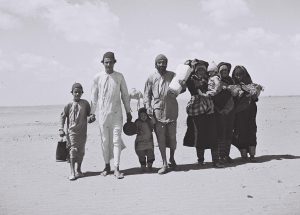
No one can ignore the Palestinian refugee problem. Yet no one speaks of the predicament of the larger number of Jews expelled from the Arab states in the wake of Israel’s establishment. Having failed to abort the newly established Jewish state by force of arms, these states took revenge on their own Jewish communities, some of which had lived in those lands way before their Arab/Muslim conquest in the seventh century CE.

About 900,000 Jews of Arab countries were forced to leave their homes, and their properties were summarily expropriated. In some of those countries, primarily Egypt and Iraq, that stolen property is estimated today in the hundreds of billions of dollars. This includes many buildings and hundreds of beautiful synagogues, enterprises, and private assets that were confiscated solely because their owners happened to be Jews.

Those Jews were expelled and/or forced to flee their homelands in fear of their lives. They were subjected to persecution and numerous pogroms, though they had in no way harmed their Arab compatriots – unlike the Palestinian refugees, who fled in the wake of a war of annihilation that their leaders and the Arab regimes had waged.

As part of the recent Arab League summit in Jordan, the 2002 Arab Peace Initiative was revived. It offers Israel normalization with the Arab and Muslim states in return for a withdrawal from Judea and Samaria and the establishment of a Palestinian state with Jerusalem as its capital.

Not surprisingly, the statement issued by the summit demands concessions only of Israel. If, however, Jerusalem decides to enter peace talks on the basis of this plan, it must demand an explicit apology from the Arab states that expelled their Jewish citizens in the course of the conflict. Israel must further insist that these Jews be compensated for the loss of their earthly properties and for the suffering attending their expulsion.

Over the course of history, countless peoples have afflicted the Jewish people. Some have apologized, and some have even tried to atone for their misdeeds. For example, the Portuguese and the Spanish have apologized for their persecution of Jews, and now offer passports to all Jews whose families were expelled from those countries, as far back as the Expulsion of 1492. The Germans, who annihilated one-third of the Jewish people, have apologized, signed a reparations agreement with the state of Israel, and compensated numerous Holocaust survivors.

In contrast, the Arab states are not only unwilling to pay compensation to those Jews they expelled, but refuse to acknowledge this atrocity in the first place. The time has come for these states and their leaders to own up to their misdeeds, apologize for this injustice, and compensate those whose property they stole.

Israel can help to redress an historical injustice if it makes it unequivocally clear that it will not sign an agreement on ending the conflict with the Palestinians and/or the Arab states until the issue of the Jewish refugees and their plundered property in the Arab countries is resolved.

As the state of the Jewish people, Israel has a supreme moral duty, along with a right anchored in international law, to demand that the Arab states compensate their past Jewish citizens for the assets and lands that were illegally and unjustifiably wrested from them.

Unfortunately, Israeli governments have thus far ignored this issue altogether. One can only hope that the current and future governments will come to their senses as soon as possible, since no solution for the Palestinian refugee problem is possible so long as justice is not served for the Jewish refugees from the Arab states.

View PDF

Dr. Edy Cohen is author of the book The Holocaust in the Eyes of Mahmoud Abbas (Hebrew). 

BESA Center Perspectives Papers are published through the generosity of the Greg Rosshandler Family

In a City Gripped by Shock, Manchester Jews Unite in Sorrow and Determination After Concert Suicide Bombing

Concertgoers fleeing the Manchester Arena following Monday’s terror attack. Photo: YouTube screenshot.

Manchester’s Jewish community joined with the rest of their city in sorrow and disbelief on Tuesday, following the devastating terrorist atrocity outside a pop concert on Monday night in which 22 people lost their lives and more than 50 were wounded.

“I was very distressed this morning, I was quite tearful,” Manchester-born Rabbi Benjamin Simmonds told The Algemeiner. “The mood here today is somber, but very determined. People are very resilient.”

A few children from the Jewish community had attended the concert by US pop star Ariana Grande, but none were reported to be among the casualties, Simmonds said. Volunteers from the Chabad movement were out on the streets of Manchester after the blast, bringing hot food and drinks to emergency workers and survivors.

MAY 23, 2017 1:47 PM
0

Rabbi Brings Refreshments, Food to Police on Guard Outside Manchester Arena Following Deadly ISIS Suicide Bombing

A rabbi handed out hot beverages and food on Tuesday to police officers standing guard outside the Manchester Arena, where a...

Simmonds, the rabbi of the Stenecourt Synagogue on the edge of Manchester’s city center, recalled that he himself had walked past the Manchester Arena — the site of the suicide bombing attack carried out, police say, by-22 year-old Salman Abedi, reportedly born in the UK to a Libyan immigrant family living in the city — only a few hours before the explosion.

“I was on my way to an event to promote community harmony,” he reflected sadly.

Jewish organizations in the UK were in a heightened state of alert the day after the bombing, which ISIS claimed responsibility for. On its website, the Community Security Trust (CST) — a volunteer organization that works with police in providing security to the UK Jewish community — said that it “stresses that there is no specific information indicating a planned attack against British Jews at this time, but all Jewish locations have been asked to ensure that security measures are fully implemented.”

The Jewish Representative Council in Manchester released a statement on Tuesday calling for a united front in the face of the attack.

“Our commitment is to unite and remember that Manchester is a great city made up of many communities,” the statement said. “A city that has faced adversity over the years. A city that has always recovered because of the resilience of all its communities.”

Rabbi Simmonds — who came to national attention in 2007, when he spoke out forcefully against antisemitism after being violently assaulted by an antisemitic gang — emphasized that relations between local Jews and police were close. He noted that the police had been very supportive of the community during the Gaza War of 2014, when BDS protesters attempted to shut down the Israeli Kedem cosmetics store in the city center.

About 25,000 Jews live in Manchester, which has the second largest Jewish population outside of London in the British Isles.

Rabbi Simmonds warned against reprisals or abuse directed towards members of the Muslim community. “We don’t want a backlash,” he said.

Sunday, 21 May 2017

'Netanyahu may be as great as David and Solomon'

Rep. Louie Gohmert says he told Israel's prime minister he could be one of the all-time great leaders of Israel – and recalls his response.

Speaking at the US Capitol at a special event marking the 50th anniversary of Jerusalem's liberation and unification, Rep. Louie Gohmert (R-TX) said he told the Israeli prime minister he could be one of the all-time great leaders of Israel – and recalled his response.

Gohmert was flanked by Martin Oliner, President of the Center for Righteousness and Integrity and of Religious Zionists of America. This is the text of his speech:

[Gohmert recalled telling Binyamin Netanyahu,] "I'm a student of history, I'm a student of the Bible. I'm not a prophet, don't pretend to be, never could be, but, I think you have a chance to be one of Israel’s greatest leaders." And Michelle Bachmann was with me and she said, 'Well, he is one of Israel's greatest leaders'. I said, No no no, I'm talking all-time greats. Going back to David, Solomon, Josiah, Hezekiah (for most of his time), on up to Ben Gurion, but all of them had one thing in common besides being Jewish. They all called upon the Nation of Israel to honor the God of Abraham, Isaac and Jacob, and that has not happened in a very long time.

And he said, last time I brought it up, he said – "Well, you may not be aware, but I've started a Bible study in my house since you last [were here]. I said I was aware, I was thrilled. And he said, "OK, here's something you could not know. My favorite hour each week is when my son comes over and we read Scripture and we talk about it. My favorite hour of the week".

Well, the first time I brought it up, he said, "That reminds me of that story about Ben Gurion, after he fought his way back up to Jerusalem. And he was challenged: 'What is your voucher for claiming this land?' And Netanyahu didn't use the word Bible, I'm sure it's Tanakh or Torah. He says, "He held up a Bible and said. 'This is my voucher'".

Well, it's quite a deed, I think.

So… We need to be the best friend Israel can have. I don’t think we have been as good a friend as we should have been. I think betraying the trust of Israel is not a good way to be a friend, but we need to work together. We have a democracy, a democratic republic in the middle of the Middle East, in the middle of countries that would like to see Israel gone.

AIPAC got mad at me the time I voted against three billion for Israel. It was not because of that. I would have voted for four, five, six – but we were giving Israel's enemies an equal amount and I think that's outrageous. You're not making any progress when you're giving Israel one amount and their enemies the same amount. That's a mistake.

Il also tell people here, if there were no Israel, we could never set up the kind of defense we need in that part of the world to protect us here, for the kind of money we're giving to Israel. And of course, you know most of it comes back to us for defense materiel.

I’m looking forward to the next three and a half years and hopefully far beyond that. I think Israel is going to be blessed and I think the best way for the United States to be blessed is not to be cursing Israel but to be a blessing to Israel, and that’s what I intend to be.

If you think the solution in Israel is two states out of the Promised Land, your faith in your God is much too small.

Israeli Education Group Reaches 1,000 French Students

(JTA) – An Israel-based Jewish educational group, Dirshu, has enrolled its 1,000th student in France into classes devoted to studying the Talmud, a central text of Orthodox Jewish tradition.

The current level of enrollment was reached two years after Dirshu, which was founded in 1997, began its current cycle of study in France, Rabbi Naftali Levy, Dirshu’s head of operations in France, told JTA Wednesday.

The organization, which is active in the United States, Canada, Israel and beyond, facilitates group and online learning sessions of segments from the Talmud as a means of reinforcing Jewish identity and knowledge among Jewish communities. The annual budget of its operations in France is roughly $80,000, a spokesperson for the group said.

France has 500,000 Jews and a network of Chabad-affiliated educational institutions that are among the country’s best schools.

However, Levy said, whereas France has thousands of young men who attend yeshivas, or religious seminaries, with intensive curricula, and a vibrant Jewish cultural scene, there is a “gap of knowledge among ordinary Jews with traditional or Orthodox backgrounds. We give them the means to deepen their knowledge,” he told JTA.

Read more: http://forward.com/fast-forward/372568/israeli-education-group-reaches-1-000-french-students/

Saturday, 20 May 2017

Church of Scotland moots Israel sanctions over West Bank homes


Members of the Church of Scotland are to be asked to back economic sanctions against Israel in protest against the growing number of settlements on the West Bank.

Commissioners — or delegates — will vote on a tough new stance at the general assembly of the Church of Scotland, which opens in Edinburgh today.

Four years ago the Israeli government condemned the kirk for boosting political extremism and challenging the country’s right to exist.

Should the latest policy be approved when they convene on Monday, the church will lobby the UK government to begin a boycott of Israeli goods.

An intervention by the Rev Tom Gordon, chaplain of the Marie Curie Hospice in Edinburgh, is asking the church to “condemn all infringements of international law, including the expansion of the illegal settlements, which are obstacles to peace, and urge the adoption of economic measures to pressure the state of Israel to comply with international law”.


Mr Gordon’s counter motion was published last night and follows a report by the kirk’s world mission council that drew criticism from Scotland’s Jewish community when it was issued four weeks ago.

This earlier document discussed how the church might “creatively resist the occupation of Palestinian territory” but stopped short of recommending sanctions.

It was, however, met with the “considerable reservations” of the Scottish Council of Jewish Communities. The council was not available for comment on the proposed amendment.

In 2013, a ten-page report published by the kirk said the Jews’ claim to the land of Israel could be invalidated by their treatment of Palestinians. It recommended that the general assembly considered “economic and political measures involving boycotts, disinvestment and sanctions against the state of Israel focused on illegal settlements”.

After the report was widely criticised, it was extensively rewritten by the church. The next year, in a symbolic gesture of friendship, the chief rabbi addressed the General Assembly.

In January, Israel approved the construction of 2,500 homes in West Bank settlements, a sign of a policy shift after Donald Trump’s election as US president. Most of the construction is in settlement “blocs” that are likely to remain part of Israel in a final agreement with the Palestinians.


However, 900 of them would sit more than 12 miles into the West Bank. It will be the largest batch of construction since 2012, when Israel announced 3,000 new homes after the Palestinians joined the United Nations.

This year’s week-long conference begins this morning and will include an address by Princess Anne, the first member of the royal family to serve twice as a high commissioner in the Church of Scotland.

Church of Scotland moots Israel sanctions over West Bank homes

https://feeds.thetimes.co.uk/web/imageserver/imageserver/image/methode%2Ftimes%2Fprod%2Fweb%2Fbin%2Fb18b0584-3cdc-11e7-8a07-589c316ac3ec.jpg?crop=3366,1893,10,336&resize=1370<

Members of the Church of Scotland are to be asked to back economic sanctions against Israel in protest against the growing number of settlements on the West Bank.

Commissioners — or delegates — will vote on a tough new stance at the general assembly of the Church of Scotland, which opens in Edinburgh today.

Four years ago the Israeli government condemned the kirk for boosting political extremism and challenging the country’s right to exist.

Should the latest policy be approved when they convene on Monday, the church will lobby the UK government to begin a boycott of Israeli goods.

An intervention by the Rev Tom Gordon, chaplain of the Marie Curie Hospice in Edinburgh, is asking the church to “condemn all infringements of international law, including the expansion of the illegal settlements, which are obstacles to peace, and urge the adoption of economic measures to pressure the state of Israel to comply with international law”.

Mr Gordon’s counter motion was published last night and follows a report by the kirk’s world mission council that drew criticism from Scotland’s Jewish community when it was issued four weeks ago.

This earlier document discussed how the church might “creatively resist the occupation of Palestinian territory” but stopped short of recommending sanctions.

It was, however, met with the “considerable reservations” of the Scottish Council of Jewish Communities. The council was not available for comment on the proposed amendment.

In 2013, a ten-page report published by the kirk said the Jews’ claim to the land of Israel could be invalidated by their treatment of Palestinians. It recommended that the general assembly considered “economic and political measures involving boycotts, disinvestment and sanctions against the state of Israel focused on illegal settlements”.

After the report was widely criticised, it was extensively rewritten by the church. The next year, in a symbolic gesture of friendship, the chief rabbi addressed the General Assembly.

In January, Israel approved the construction of 2,500 homes in West Bank settlements, a sign of a policy shift after Donald Trump’s election as US president. Most of the construction is in settlement “blocs” that are likely to remain part of Israel in a final agreement with the Palestinians.

However, 900 of them would sit more than 12 miles into the West Bank. It will be the largest batch of construction since 2012, when Israel announced 3,000 new homes after the Palestinians joined the United Nations.

This year’s week-long conference begins this morning and will include an address by Princess Anne, the first member of the royal family to serve twice as a high commissioner in the Church of Scotland.