Search This Blog

Wednesday, 10 January 2018

Migrants must visit Nazi concentration camps, Germany's Jewish council says


Image Caption and Rights Information
Such visits have long been a staple of high school education in Germany
BERLIN, Jan 10 (Reuters) - New migrants to Germany must visit Nazi concentration camp memorials to help tackle a perceived rise in anti-Semitism, Germany's Central Council of Jews said on Wednesday, supporting a proposal by a Palestinian-German politician.
Anti-Semitism remains a sensitive issue in Germany, one of Israel's closest allies, more than 70 years after the end of the Nazi-era Holocaust, in which 6 million Jews were killed.
The government decried as shameful the spectacle of the Israeli flag being burned at demonstrations last month against U.S. President Donald Trump's decision to recognise Jerusalem as Israel's capital.
Josef Schuster, head of the Central Council of Jews expressed support for a proposal by Sawsan Chebli, a Berlin state senator, for mandatory visits by newly arrived refugees to Nazi concentration camps memorials.
"People who have fled to us who have themselves had to escape or been expelled, can develop empathy in such memorials," Schuster told Deutschlandfunk radio on Wednesday.
Germany has received well over a million migrants fleeing war and poverty in the Middle East and Africa.
Germany is home today to an estimated 200,000 Jews and has built a reputation in recent decades as a tolerant, safe place for Jews to live - though data shows anti-Semitic crimes reported to the police rose 4 percent to 681 in the first eight months of 2017 from the same period in 2016.
"It makes sense for everyone living in this country to be obliged to visit a concentration camp memorial site at least once in their lives," Chebli told Bild am Sonntag newspaper on Sunday when she first floated the proposal.
She said such visits, long a staple of high school education in a country determined that the lessons of its history not be forgotten, should also be extended to new migrants, who should make trips as part of their compulsory integration courses.
Currently, the integration courses focus on learning the German language and about Germany's history, culture and its legal system
Asked about the possibility of mandatory visits to concentration camps, a spokeswoman for the Federal Office for Migration and Refugees ministry said the integration course for immigrants already had a module regarding the consequences of the Nazi rule for the people of Germany and Europe.
Last month, Germany's justice minister called for more emphasis on the Holocaust in migrants' integration courses.
Schuster said everyone who wanted to live permanently in Germany must identify with its history.
Such visits, which should be prepared by schools, would show where anti-Semitism and hatred for Jews could lead, he said.
(Reporting by Riham Alkousaa; Editing by Alison Williams)

Turkish Jews Denounce Antisemitic Tabloid’s Claim That ‘Jewish Businessmen’ Manipulated Financial Markets Ahead of Failed 2016 Coup

by Ben Cohen

The entrance to Istanbul’s Bourse, or stock exchange. Photo: Reuters / Murad Sezer.
A mass-circulation, pro-government newspaper in Turkey has been roundly condemned by the country’s Jewish community after it accused “Jewish businessmen” of engaging in suspicious transactions on Turkish financial markets in the run-up to the abortive coup against President Recep Tayyip Erdoğan in July 2016.
In an article billed as an investigative report published by the conservative tabloid Yeni Şafak (“New Dawn”) on Tuesday, reporter Osman Özgan claimed that Turkish authorities had discovered “hundreds of suspicious transactions” before July 15, 2016 — the day the coup was launched.
“It became evident that nearly 60 businessmen had withdrawn from the market, selling all their shares on and before July 15,” Özgan wrote. “Among these names are also some Jewish businessmen and international corporations.” None of the individuals was explicitly named, and Özgan did not specify how many of them were Jews  — or why the fact of their being Jewish was relevant to the authorities’ inquiries.
On its official Twitter feed, the Turkish Jewish community denounced the article as an “antisemitic provocation” and an example of “hate rhetoric.”
Özgan’s report was apparently based upon an ongoing investigation by the Ankara Chief Prosecutor’s Office into whether the highlighted transactions prove that those investors selling Turkish stock were given advance warning of the coup. In that regard, Özgan claimed to have seen the details of a phone call between an unnamed businessman and his broker on the day of the coup — a Friday — in which the businessman supposedly said, “Some big things will happen on Monday.”
At the heart of the accusations laid out by Yeni Şafak are the Turkish Muslim cleric Fethullah Gülen and his supporters. Based in the US since 1975, Gülen — a billionaire and former close ally of Erdogan — is charged by the Turkish president with having orchestrated the 2016 coup attempt.
One of the companies under investigation over the financial market transactions — the conglomerate Koza İpek, said to be tied to Gülen  — has been a favorite target of the Turkish government since the coup, with its 20 media outlets now either shut down or under the supervision of government-appointed trustees. Additionally, in May 2017, Turkish police detained 53 former employees of the Istanbul stock exchange over alleged links to Gülen, as part of a wider purge of business, government and media institutions following the coup.
The article ended with Özgan again emphasizing that “those withdrawing from the stock market included some Jewish businessmen and representatives in Turkey of some international corporations.”
“It is stated that those people, after selling their shares, converted large amounts of Turkish Lire into gold and foreign currency which will not lose value,” he claimed.
Yeni Şafak has long had the reputation of being one of the most antisemitic outlets in Turkey. Over the last decade, its columnists have published numerous articles accusing of Jews of “empowering” the “destruction of Islam by the USA.” It has also described Zionism as a “Jewish pathology,” and demanded that Turkish Jews, suspected of “dual loyalty,” condemn Israel. In September 2017, the paper enthusiastically pushed the conspiracy theory — also voiced by Erdoğan — that the independence referendum in Iraqi Kurdistan was an “Israeli plot” to resettle 200,000 Kurdish Jews in the region.
Louis Fishman — an assistant professor at Brooklyn College CUNY who writes extensively on Turkish affairs — told The Algemeiner on Wednesday that as well as the official Jewish community condemnation, “other members of the small Jewish community, together with Muslim counterparts who stand against antisemitism, joined in expressing their disgust” at the article.
Fishman observed that the response from the Jewish community reflected a growing willingness to call out antisemitic provocations. “The community’s swift condemnation, even if it was countered with some antisemitic tweets, marks a growing and much-needed trend of its members challenging public displays of antisemitism — which historically has crossed political lines, even if today it is much more prominent within the pro-government press,” he noted.
With the latest Yeni Şafak missive, Fishman said, “the message of the Jewish community was clear.”
“The singling out of Jewish businessmen, despite the fact that they are Turkish citizens, is antisemitic,” he said.
“Of course, with antisemitic conspiracy theories in Turkey rampant, claiming that a group of Jews had previous knowledge of the failed coup strike fears that some of members of the community could get caught in purges and arrests, with greater repercussions in store for the community at large,” Fishman added.
He noted too that the focus on Turkish Jews “verges away from the more widespread beliefs about an international Jewish conspiracy prevalent among a sizable group in Turkey — which makes the community’s response even more important.”

Famous Lebanese Fashion Designer Removes Photo of Israeli Actress Gal Gadot From Instagram After Backlash


Gal Gadot. Photo: Instagram.
Renowned Lebanese fashion label Elie Saab removed a photo of Israeli actress Gal Gadot from its official Instagram page on Wednesday following intense backlash from social media users.
The photo showed the “Wonder Woman” star wearing a Saab design to the National Board of Review annual gala, which took place on Tuesday in New York City. Shortly after the picture was uploaded, which included a caption calling Gadot “flawless,” comments starting pouring in, bashing the fashion label’s media management team for praising the actress.
Screenshots of the photo and the comments posted about Gadot were taken by the Dubai-based publication StepFeed. One online hater wrote, “I  don’t have a problem with her wearing @ElieSaabWorld but I do have a problem with posting her picture from Elie Saab’s account and bragging about an ex-Israeli soldier wearing his dress! Don’t ruin one the few things that make us proud Lebanese people!”
The fashion house removed the photo soon after.
Gadot has not responded to the controversy, but this is not the first incident involving Lebanon and the actress. Lebanese authorities last year banned “Wonder Woman” from screening in the county after activists of the boycott, divestment and sanctions (BDS) movement campaigned against the film.

U.S. Ambassador to Israel: Palestinian Reactions to Terror Killing Show Why There’s No Peace

U.S. Ambassador to Israel: Palestinian Reactions to Terror Killing Show Why There’s No Peace

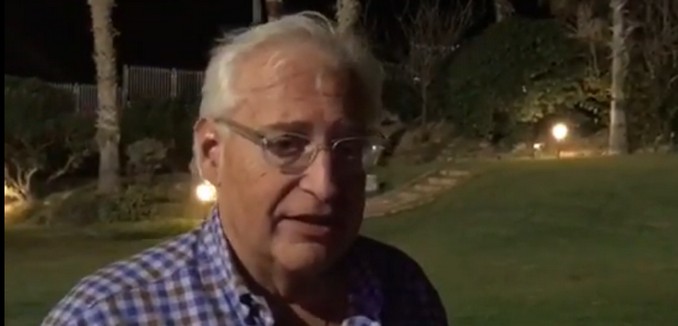
United States Ambassador to Israel, David Friedman, said in a post on social media on Wednesday that those wondering why no peace can be achieved between Israelis and Palestinians should look no further than Tuesday night’s murder of Rabbi Raziel Shevach and the Palestinian reaction to it, The Jerusalem Post reported.
“An Israeli father of six was killed last night in cold blood by Palestinian terrorists. Hamas praises the killers and PA [Palestinian Authority] laws will provide them financial rewards,” Friedman wrote on his Twitter account. “Look no further to why there is no peace. Praying for the bereaved Shevach family,” he added.
Rabbi Raziel Shevach, a father of six children and resident of Havat Gilad, was shot multiple times in his neck and upper body in a drive-by attack carried out by a Palestinian terrorist in the West Bank. Shevach was evacuated in critical condition to Meir Hospital in Kfar Saba, where he was later pronounced dead.
In response to the murder, Hamas issued a statement praising the attack. “We bless the heroic Nablus operation which comes as a result of the Zionist occupation’s violations and crimes at the expense of our people in the West Bank and Jerusalem.”
Fatah, the party headed by PA President Mahmoud Abbas, posted a message on Facebook boasting of “a killed settler.”
Meanwhile, Israeli Deputy Foreign Minister, Tzipi Hotovely, responded to Ambassador Friedman’s tweet, thanking the United States for standing with Israel and for trying to bring an end to the Palestinian Authority’s sponsorship of terrorism.
“Dear Ambassador Friedman, we deeply appreciate your solidarity with Israel,” said Hotovely, adding that “We value your partnership in the fight against terror and your understanding that the Palestinian Authority’s support of terrorists lies at the root of the problem.”
United Nations Special Coordinator for the Middle East Peace Process, Nickolay Mladenov, also condemned the attack on social media. “There is no justification for terror and those who condone it, praise it or glorify it. This is not the path to peace! The perpetrators of yesterday’s attack must be brought to justice,” he wrote.
Tuesday’s attack comes at a time when a report by the Israeli Ministry of Defense revealed that terrorists and their families are handsomely rewarded for their crimes by the Palestinian Authority. Last year, they paid NIS 687 million ($198 million) to so-called “martyrs’ families fund” and NIS 550 million ($160 million) to the Palestinian Prisoners’ Club — some 7 percent of its overall budget.
The Trump administration has reportedly been frustrated by Abbas’s refusal to denounce terror against Israel. In a public appearance with Abbas in May of last year, President Donald Trump told the PA’s leader that “Peace can never take root in an environment where violence is tolerated, funded and even rewarded.”
[Photo: Alexander Muss High School in Israel / YouTube]


Vienna police charge 3 for waving Israeli flag

“Showed an Israeli  Jewish flag at a rally in an extremely provocative way and manner that was visible for participants racists at the rally and thereby produced considerable offense and provocation among the Palestinian anti-Semitic protesters.”
SG


BERLIN – The Vienna police are pursuing criminal charges against three pro-Israel activists for waving an Israeli flag in protest of antisemitic slogans at a demonstration against Jerusalem having been recognized by the US as the capital of the Jewish state.

THE POLICE ARE SEEKING A €100 FINE OR TWO DAYS IN JAIL FOR THE DISPLAY OF ISRAEL-SUPPORT AT THE DECEMBER 8 ANTI-ISRAEL RALLY NEAR THE US EMBASSY IN AUSTRIA’S CAPITAL.
The criminal notice, dated January 3, states that the activists “showed an Israeli flag at a rally in an extremely provocative way and manner that was visible for participants at the rally and thereby produced considerable offense and provocation among the Palestinian protesters.”

The German-language edition of the news site Vice first reported on Tuesday on the penalties against the three men and conducted an interview with one of the pro-Israel protesters.

“My mother is Israeli, her family [members] are refugees from Iraq and Libya,” the pro-Israel protester said. “An Arab-speaking friend from Israel was able to translate some of the slogans yelled [at the rally], for example, the Arab battle cry to massacre Jews: ‘Jews, remember Khaybar, the army of Muhammad is returning,’ and... ‘Death to Israel.’”
The Arabic cry references an ancient Muslim attack on Jews in the town of Khaybar in what is now Saudi Arabia, killing many and looting their homes. The provocative chant is frequently used when attacking Jews and Israelis, and was chanted on the Mavi Marmara Gaza flotilla ship in May 2010.
 The activist, who was given the name Matthias  F. by Vice to ostensibly protect his privacy, said he heard other chants of “Intifada” and “Child-murder Israel” at the rally that was attended by hundreds of anti-Israel protesters.

He added that, “We were shocked by these slogans and did not want to leave the slogans unchallenged. Antisemitism and hate of Israel should not be tolerated.”

Vice showed a copy of the police notice with the criminal penalties on its website. The notice said the pro-Israel activity was “especially reckless,” which “disturbed the public order.”

The police, according to Matthias, made efforts to discourage the waving of the Israeli flag, but the protesters were permitted to wave the Palestinian and Turkish flags.

Immediately after Matthias and his friends rolled out the Israeli flag they were confronted by Palestinian demonstrators, who triggered a scuffle with the pro-Israeli activists, according to the Vice interview. 
The police confiscated the Israeli flag and took down the personal information of the three men. The Palestinian attackers were allowed to return to the demonstration.
Matthias said the prosecution is “unbelievable. We simply held a flag.” He said the men plan to seek legal aid and appeal the penalty. “It can’t be that antisemitic slogans can be hollered and go unpunished while showing an Israeli flag is reason to be fined.”


The French-Jewish Athlete Who Saved Thousands of Children from the Nazis


Now living in Paris at the age of one hundred and seven, Georges Loinger was an accomplished runner whose blond hair and blue eyes disguised his Jewish origins. In 1941 he began teaching physical education at a home for Jewish refugee children in southern France, then ruled by the pro-Germany Vichy regime. After it became clear that it would be only a matter of time before the children were deported to the death camps in Poland, Loinger was given the task of getting them to Switzerland. Robert Rockaway and Maya Guez tell his story:
From his home in the 16th arrondissement, Loinger, related one of the methods he used to rescue children and get them over the Swiss border. “I used to play with the children in the residences where they lived in France and trained them to run. One day, . . . I took the children to the border of France with Switzerland, next to Geneva, and told them we are going to play with a ball like we used to do. I threw the ball a hundred meters toward the Swiss border and told the children to run and get the ball. They ran after the ball and this is how they crossed the border. This is how their lives were saved. . . . .
Until 1943, when Italy withdrew from France, the border with Switzerland was guarded “lightly” by Italian troops, who turned a blind eye to the . . . smuggling operation. Loinger also knew the mayor of the [nearby] town of Annemasse on the border with Switzerland, five miles from Geneva. The mayor, Jean Deffaugt, owned a men’s clothing store. Loinger met with him and told him . . . of his plan to save Jewish children. The mayor told Loinger that what he planned to do was extremely dangerous, but he agreed to help him. He allowed Loinger to bring the children to his village and housed them there until it was time for them to go. . . . Loinger alone save more than 400 children. . . .
Once Loinger had secured his own family’s safety in Switzerland, he continued his rescue work until the liberation. After the war, he opened an accommodation center for war prisoners and deportees. In 1947, he worked for Aliyah Bet (illegal immigration) to help Holocaust survivors immigrate to Palestine. He also played a major role in preparing the ship Exodus for sailing when it stopped in France. In 1949, he became the French director of ZIM, the Israeli national shipping company.

Rivlin: We must renew our partnership with the Diaspora


At the "Globes" Israel Business Conference, President Reuven Rivlin also called for strengthening Israeli research and academic institutions.


"The changes in the Middle East, in the global economy, make our reality more complicated. Nevertheless, there is one thing that is not complicated, and that is Israel's need to strengthen its economic presence in the international arena. Two decades into the twenty-first century, it seems that the world is abandoning the great ideologies of the twentieth century and returning to the naked interests that characterized the nineteenth century, and there is less pretense," president of the State of Israel Reuven Rivlin said today at the "Globes" Israel Business Conference.
Rivlin said that Israel needed to exploit its special abilities. "The fact that we are a power in security and science and that we are a force for progress in the world gives us a very strong position. Today, Israeli technology is to be found in every Intel processor, and at Facebook, at Google, and at Amazon.
"A large part of the world's hardware and software industry comes from Israel, and that gives us a highly significant geo-political lever. When they need your abilities and brains, it's less easy to join in anti-Israeli initiatives at the UN. But that isn’t enough: as long as our exports mostly depend on a special kind of mind, our ability will be limited. There are two further fronts on which we must develop: life science, and agriculture."
On the crisis at pharmaceuticals giant Teva, Rivlin said, "We all feel the upset at Teva, but this is the time to recall the conditions that enabled Teva to flourish and prosper for many years. This is the time to raise the level of research and academic prowess, and reinforce the medical daring that have brought Nobel prizes to Israel. This is the time to help this industry overcome and mature, and to extract the most from its ability to contribute, both to the labor market and to Israel's world standing."
Rivlin called for the construction of a long-term vision that would ensure the realization of Israel's potential in the world. "The time is ripe for creating a vision and a general strategy for the next 30 years, as a coordinated process involving the government and the private market. Within that, there is room for looking at joint action with the Jewish Diaspora on this and other matters, and for creating a new axis of partnership. We would like to strive for a reality in which Israel the innovator and Israel with all its capabilities, together with Diaspora Jewry, will be a main partner in dealing with global development problems."
Published by Globes [online], Israel business news - www.globes-online.com - on January 10, 2018
© Copyright of Globes Publisher Itonut (1983) Ltd. 2018