I am not an historian, decent author or a journalist, and the chances are that unless there is a link or reference to somewhere else, the perpetrator is yours truly – Renaud Sarda. I created this blog as a focal point, to arm people with arguments and facts that they can perhaps use to counter biased media reporting and anti-Israel propaganda, and to help counter (BDS) campaign. I am a Zionist/Sephardi/Jew who will fly the Israeli flag, and defend whatever Israel does.
The Mayor of Bury, Cllr Jane Black, and other dignitaries at the We Were There Too launched in Manchester. Photo: Mike Poloway
A NEW digital archive immortalising the contribution of members of the region's Jewish community to the First World War has been unveiled.
The We Were There Too project represents a permanent record of the lives of Jewish men, women and families between 1914 and 1918, and details their military service and efforts on the home front.
First introduced in London in 2016, the project has now been extended to the North West thanks to a Heritage Lottery Fund Grant.
The Mayor of Bury, Councillor Jane Black, attended the project's launch ceremony at the King David High School in Manchester alongside other civic, military and religious leaders.
Another launched ceremony was also held at Princess Road Synagogue in Liverpool.
Cllr Black said: "I attended this important event as Mayor, along with my husband Mark. Bury is a proud army town and it was so interesting to hear about this project as mayor, but also as a Jew whose father, uncles and grandfather fought in the British Army."
At the launches a series of emotive readings were given by young people and members of the Jewish community, including poems by Jewish war poets Isaac Rosenberg and Siegfried Sassoon.
A moving act of remembrance then followed, led by Reserve Army Chaplain Rabbi Ariel Abel.
The We Were There Too database will offer an insight into Jewish life in Britain in the early 20th century through a number of research resources which have been brought together for the first time.
In the future more collections of rare material will be added, and, in keeping with Jewish tradition, the site will also allow visitors to permanently memorialise their ancestors to commemorate their deaths annually.
Cllr Black said: "As the years pass by and our ancestors are no longer with us, it is important to find ways to remember. The web technology used here will help us make the history of families and our country available to new generations.
"I was particularly moved to hear how some families are now able to say memorial prayers on the anniversaries of their ancestors’ deaths, so that their lives are now being remembered.
"My own grandfather fought in the First World War, and I hope to find out more about what he did through this project."
The project is now appealing from people to volunteer and help maintain the collections.
Volunteers will be offered training in research, handling historical information, technology project planning and communication.
Alan Fell, the We Were There Too project senior consultant, said: “We are now asking people to volunteer to help us maintain this important and valuable asset.
"Whatever your age, knowledge of the First World War, research experience or understanding of computers, if you think you have a family member who lived in Britain during the war, or are interested to research a name in the British Jewry Book of Honour, on a Synagogue Memorial Board, a gravestone or a host of other memorials, then we will help you to find out more about them and build a Personal Record.”
For more information or to get involved visit www.jewsfww.uk or email alan@jewsfww.uk.
New research using ancient DNA is rewriting the genetic history of two ancient peoples; the Hindus and the Jews – and shows that their two religious civilization are the result of multiple ancient ethnic migrations; into the Land of India in the case of the Hindus, and into diaspora Jewish communities in the case of the Jewish People.
First the Hindus. According to Tony Joseph, author of “Early Indians’’, Hindu nationalists believe the source of Indian civilization were the people who called themselves Aryans – a nomadic tribe of horse-riding, cattle-rearing warriors and herders who composed Hinduism’s oldest religious texts, the Vedas. Aryans, they argue, originated within the Land of India, spreading themselves and their family of Indo-European languages across large parts of Asia and Europe.
Many Indian scholars question the “out of India” thesis, arguing that Indo-European language speakers – or Aryans – were just one of many streams of prehistoric migrants who came into India after the decline of the much earlier Harappan (or Indus Valley) civilization, which thrived in what is now north-western India and Pakistan around the same time as the early Egyptians and Mesopotamians.
Hindu right-wingers believe the Harappan civilization was also an Aryan or Vedic civilization; but none of their languages have been deciphered so no one knows what language they spoke.
Now studies using ancient DNA are rewriting world history, and especially for the Hindu and Jewish Peoples, there have been many fascinating discoveries.
The most recent study on this subject, led by geneticist David Reich of Harvard University, who had also studied the genetic evolution of the Jewish People, was published in March 2018 and co-authored by 92 scholars from all over the world – many of them leading names in disciplines as diverse as genetics, history, archaeology and anthropology.
The study showed that in the last 8,000 years there were two major migrations into, and not out of. India. The first one originated from the Zagros region in south-western Iran (which has the world’s first evidence for goat domestication) and brought agriculturists, most likely herders, to India.
This would have been between 6,000 and 3,000 BCE. These Zagrosian herders mixed with the earlier inhabitants of the subcontinent – the First Indians, descendants of the Out of Africa (OoA) migrants who had reached India around 65,000 years ago – and together, they created the Harappan civilization.
In the centuries after 2000 BCE came the second set of immigrants (the Aryans) from the Eurasian Steppe lands, probably from Kazakhstan who brought with them an early version of Sanskrit, mastery over horses and new cultural and religious practices, all of which formed the basis of early Hindu/Vedic culture.
A thousand years earlier these Aryan peoples from the Eurasian Steppe lands had moved into Europe, mixing with agriculturists there, and spreading Indo-European languages into Europe.
Other genetic studies have brought to light more migrations into India, such as that of the speakers of Austro-Asiatic languages who came from south-eastern Asia. Thus India’s population is made up of a number of different layers added at different times.
As Tony Joseph writes in his book “Early Indians’’, the Indian population is like a pizza, with the first Indians forming its base. Though the base is thin in some places and thicker in others, studies show that 50% to 65% of the genetic ancestry of almost all Indians derives from the First Indians.
On top of the base comes the sauce – the Harappans. Then come the various toppings and the cheese – the Austro-Asiatic, Tibeto-Burman and Indo-European language speakers or Aryans, all of whom found their way into the subcontinent later.
Hindu nationalists will not admit that the Aryans were not the first inhabitants of India; and that the Harappan civilization existed long before their arrival for it would mean acknowledging that Aryans or their Vedic culture were not the singular fountainhead of Indian civilization.
The idea of the mixing of different population groups is even more unappealing to Orthodox Hindus and Hindu nationalists as they put a premium on racial purity. Plus the migration theory puts Aryans on the same footing as latter-day Muslim conquerors of India – such as the Mughals.
Some Hindu nationalists demand that the Harappan civilization be renamed the Saraswati river civilization. Since the Saraswati is mentioned in the Rig Vedic, such a renaming would serve to emphasize the link between Harappan civilization and the Aryans.
However, Tony Joseph says the real message that the new research carries is an exciting and hopeful one: that Indians have created a long-lasting civilization from a variety of heredities and histories. The genius of the Indian civilization during its best periods has been inclusion, not exclusion. Unity in diversity is, indeed, the central theme of India’s genetic make-up.
Now to the Jewish People. I would say that the same thing can also be said for the Jewish people in the 2500 years since the Babylonian exile. After all, are all present day Jews really the biological descendants of the Jews who inhabited the Land of Israel 3.000 years ago?
Yes and No. A new genetic analysis supports the historical record of Middle Eastern Jews settling in North Africa during Classical Antiquity, actively proselytizing and marrying local populations, and, in the process, forming distinct populations that later stayed largely intact for over 1500 years.
The study was published online August 6, 2012 in the Proceedings of the National Academy of Sciences. “Our new findings define North African Jews, and enhance the case for a biological basis for Jewishness,” said study leader Harry Ostrer, M.D., professor of pathology, genetics and pediatrics at Albert Einstein College of Medicine of Yeshiva University.
However, as anyone who has been to present day Israel knows, Jews come in many shades and looks. This is because even in the diaspora, and even against the will of the ruling religious authorities, Jews have quietly welcomed converts into the Jewish community, even against the formal rules of medieval rabbis. That is why most Jews in different geographical locations tend to look similar to the local majority after several generations.
The rabbinical rule that one should not refer to any Jew’s convert status is evidence of the desire of Jewish leaders to keep proselytizing activities secret from the non-Jewish ruling religious authorities..
In a previous genetic analysis, the researchers showed that modern-day Sephardic (Greek and Turkish), Ashkenazi (Eastern European) and Mizrahi (Iranian, Iraqi and Syrian) Jews that originated in Europe and the Middle East are more related to each other than to their contemporary non-Jewish neighbors, with each group forming its own cluster within the larger Jewish population.
Further, each of the four geographical groups genes, demonstrated Middle-Eastern ancestry, plus varying degrees of inclusion of converts to Judaism from the surrounding populations. This is true even though two of the major Jewish populations — Middle Eastern and European Jews — were found to have diverged from each other approximately 2,500 years ago.
The current study which extended the analysis to North African Jews, the second largest Jewish Diaspora group found that they also were more related to each other than to their contemporary non-Jewish North African neighbors.
The current study also included members of Jewish communities in Ethiopia, Yemen and Georgia. In all, the researchers analyzed the genetic make-up of 509 Jews from 15 populations along with genetic data on 114 individuals from seven North African non-Jewish populations.
North African Jews exhibited a high degree of endogamy, or marriage within their own religious group in accordance with Jewish custom. Ethiopian and Yemenite Jewish populations also formed distinctive genetically linked clusters, as did Georgian Jews.
So I would also say that the real message that the new genetic research carries is an exciting and hopeful one: that Jews have created a long-lasting civilization from a variety of ethnic and racial heredities and national histories. The genius of the Jewish civilization during its best periods has been inclusion, not exclusion.
Unity in diversity is the central theme of the Jewish People’s genetic historical make-up, and should inspire Israel’s political leadership to do everything necessary to encourage non-Jews living in Israel to become Jewish.
While the inhabitants of the Indian sub-continent, like those of China, have always outnumbered their conquerors, and thus been able to absorb them; the Jewish diaspora has always been a small minority, so opposition to ‘outreach’ may have been a wise precaution then.
But it is very counter-productive now, when Jews are a majority in Israel. Orthodox unwillingness to increase the number of non-Orthodox Jews by accepting Conservative and Reform converts is planting the seeds for major divisiveness in Israel’s future.
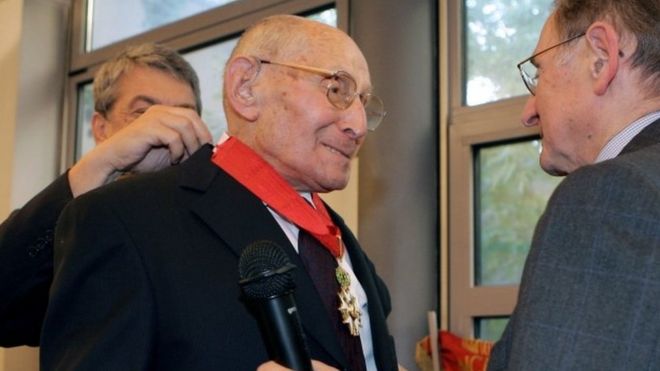
Loinger was serving in the French army when he was caught in 1940 but his blond hair and blue eyes apparently concealed the fact he was Jewish from his German captors and this enabled his escape from a prisoner of war camp.
Returning to France during the war he joined an aid agency trying to help Jewish children whose parents had been killed or sent to concentration camps.
Another method he used involved dressing children as mourners and taking them to a cemetery on the French-Swiss border, where they would climb up a gravedigger's ladder to neutral territory.
He is thought to have saved more than 350 children.
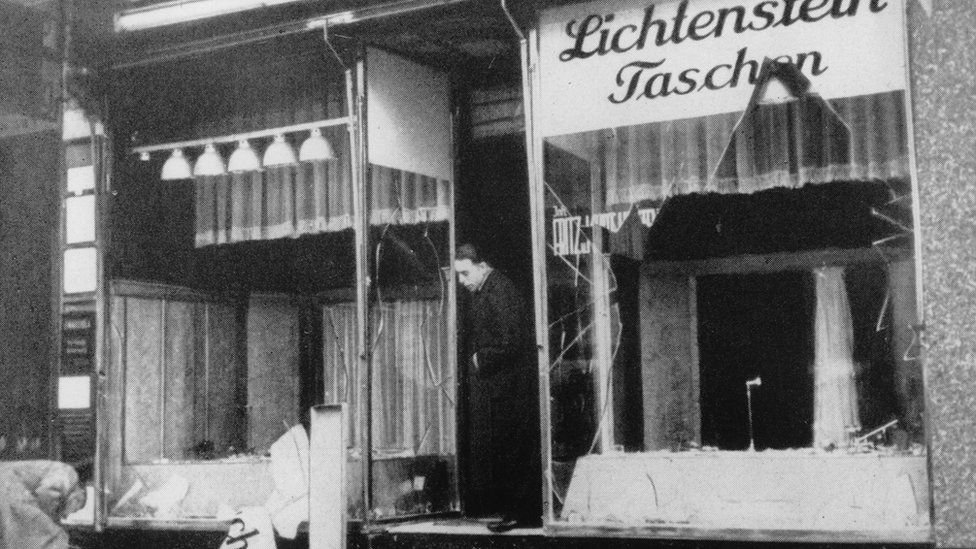
Image captionJewish shop owners had their businesses attacked
Kristallnacht
The 'Night of Broken Glass' was a significant moment in European history.
Serious, widespread violence against Jews broke out on November 9 1938. It caused the deaths of 90-100 Jewish people, and the arrest and removal to concentration camps of 30,000 Jewish men.
It was sparked by the killing of a German diplomat by a Jewish man in Paris, angry at how his family were treated.
Joseph Goebbels, Reich Minister of Propaganda, did not advocate vigilante action, but stated that if it occurred, nobody should oppose it.
Gangs attacked Jewish businesses, buildings, and synagogues and daubed them with "Juden verboten" (Jews forbidden).
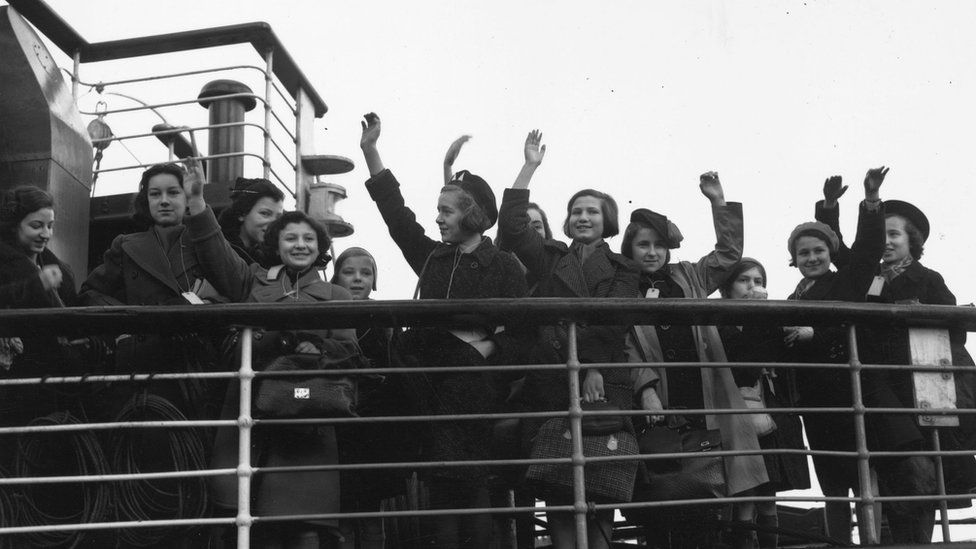
Jewish leaders in London petitioned the then home secretary, Sir Samuel Hoare, to rescue children.
In Westminster, it was decided an unspecified number of Jewish children would come to the UK temporarily as refugees, and that, after hostilities, they would reunite with family.
'A welcoming country'
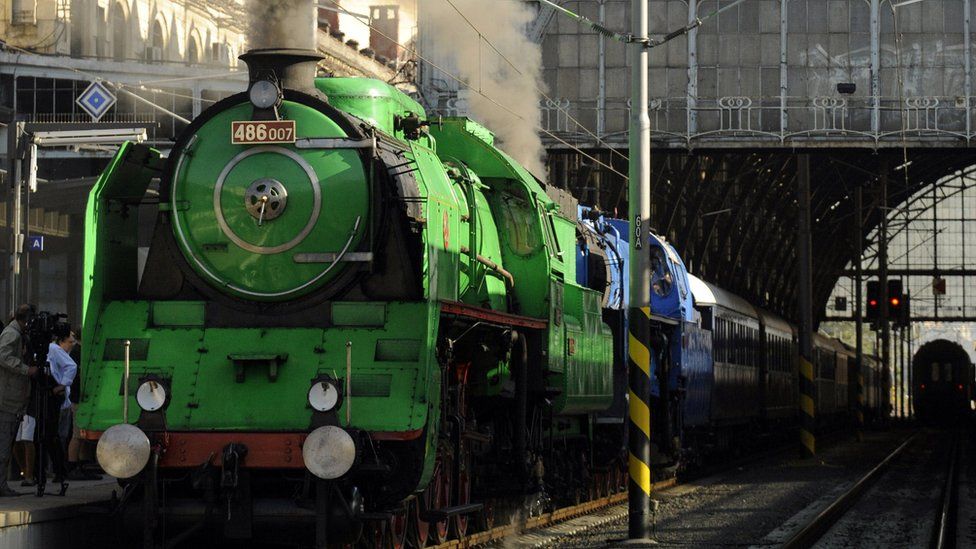
Many found the journey difficult. Karen Goodman's mother, Margit (now deceased), said how thankful they were when the train passed through Holland after departing Prague.
She said: "Mum told me how amazing it was that women came on with hot milk and bread. She remembered they were quite hungry by that stage."
Henry Wuga came to London and then Glasgow on a train in May 1939. He lived with an older Jewish lady in Glasgow.
"You're coming to a country with a different language and culture. Whether it was Wales, England, or Scotland, it didn't matter - I was glad to be here," he said.
Mr Wuga was made to feel "very welcome" by his host.
"Within a few weeks I was at school - Queen's Park School [in the Battlefield area of Glasgow].
"Nobody was abusive because we were German, or because we couldn't speak proper English, or were Jewish. On the contrary, people were very kind."
Mr Wuga's mother had previously sent him to the Black Forest to become an apprentice chef.
"She said - 'You have to learn a trade. When you leave this country you have to earn a living'."
Image copyrightGETTY IMAGES
Image captionChildren often arrived in the UK with a change of clothes and a small amount of money
He spent six months learning in Baden-Baden until Kristallnacht forced him to leave in May 1939.
Mr Wuga said, having lived away from home, "leaving home again was not new, don't get me wrong - I didn't like leaving home, but I knew I faced the world once before".
'57 varieties'
Mr Wuga even got an interesting nickname from his peers.
"You know, my name was not Henry - it was Heinz . So at school I was called '57' - you know, 57 varieties!"
This adjustment to fit in was an experience shared by other kindertransportees.
Robert Arlan says his father left Berlin three days before Robert's 18th birthday, changing his name and the family name from Manfred David Aronsohn to Fred Arlan.
Robert said his parents made the name up. "There are no more Arlans in the UK!" he added.
Scottish-cised
Stefan Paul Ludwig Brienitzer came to Edinburgh.
One factory manager approached him saying: "Please, change your name to something I can pronounce!"
Stefan Brienitzer, as he described at the John Gray Centre , became Stephan Brent - something he called "anglicised - or Scottish-cised".
This was not always the case. Margit Goodman's kept her Czech name.
Karen Goodman, her daughter, said: "There are many stories of children who reunited with their families but the gulf between them was unbridgeable.
"Children could no longer speak German or Czech nor the parents English."
She continued: "Children became anglicised. Many went to Christian homes and lost that [connection to families with] religion."
Image copyrightAFP/GETTY IMAGES
Image captionKaren Goodman's mother came from Prague on a Winton Train - named after Sir Nicholas Winton
Did they reunite?
Often, children who came to the UK did not reunite with families as parents had been killed in concentration camps.
Stephan Brent, whose story is documented on East Lothian at War , discovered what happened to his family after the war.
"They were killed in Auschwitz and my grandmother was taken to ... Treblinka where she too was killed," he said.
His mother smuggled messages off a train from Breslau to a girl loading suitcases, who subsequently went to live in Palestine.
"My Israeli half-brother's daughter was doing PhD research on the Jews of Breslau. When looking through papers she came across my mother's note - an unbelievable coincidence."
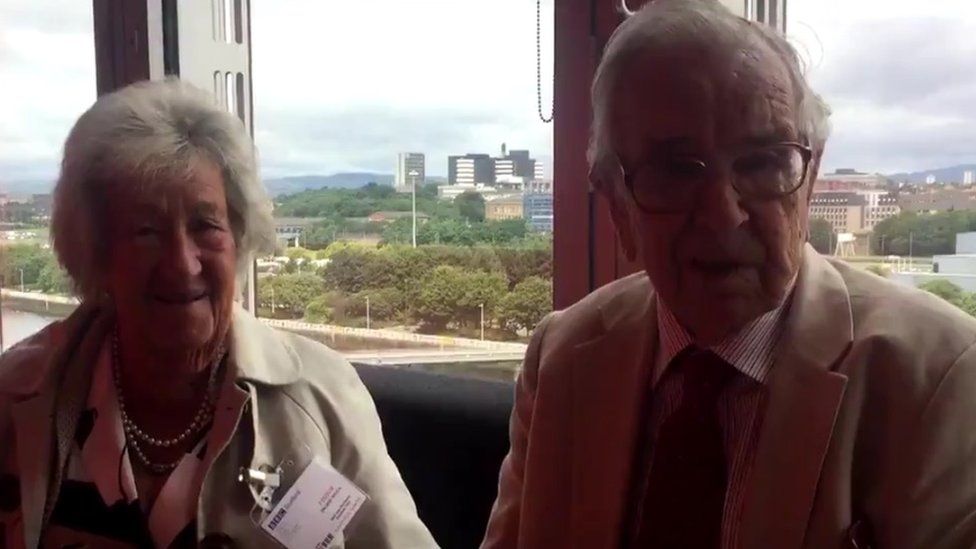
Image captionHenry and Ingrid Wuga on a visit to the BBC in Glasgow
'Scotland's my country'
Many who came to the UK settled after the war. Despite the temporary nature of the arrangement, many remained.
Margit Goodman had been "put into service" and was an untrained nurse in Glasgow during the war. She then moved to Hertfordshire.
"After the war [my mother] went to Prague to see who had survived. That's where she met my father, a trainee journalist working with a paper called 'The Soldier'," said Mrs Goodman.
After marrying, Margit moved to London and spent her life there.
Mr Wuga stayed in Scotland.
"I was a chef de cuisine [in Germany] so I worked in restaurants and hotels in Glasgow.
"Eventually with my wife [Ingrid - also a kindertransportee] we founded our own catering business that we had for 30 years."
Mr Wuga, after leaving catering, volunteered with Blesma, helping limbless veterans to ski, for which he received an MBE.
"I find that Scotland is my country now," he says "I love the country."