Search This Blog

Monday, 28 November 2011

Matoub Lounes tué à bout portant à l’extérieur de sa voiture, selon des experts français

Par Le Matin DZ, 27 novembre 2011
Le quotidien "Algérie News" citant une étude balistique faite par une équipe française à Thala Bounane qui à séjourné à Ath Douala il y a de cela dix jours, rapporte aujourd’hui que Matoub Lounes a été tué à bout pourtant à l’extérieur de sa voiture.
Selon l’étude balistique effectuée par cette équipe d’experts français, rentrés au pays avec des visas touristiques, à la demande de la famille Matoub, "Lounes a été assassiné à l’extérieur de la voiture et non à l’intérieur". L’assassin aurait tiré à bout pourtant avant de déplacer le corps dans le véhicule. Une thèse qui contredit toutes les versions rapportées jusque-là par les nombreux procès liés à cette affaire, basées sur le fait qu’aucune personne ou être vivant se trouvant à l’intérieur de la voiture n’aurait survécu aux rafales de kalachnikovs au moment de l’arrosage.
Les 78 impactes de balles relevés sur la toile ont formé ce que les experts qualifient de "toile d’araignée". Le scénario avancé par l’équipe balistique suggère que Lounes Matoub, son épouse Nadia ainsi que ces deux belles sœurs Ouardia et Farida ont été sommés de sortir du véhicule. D’après l’étude de ces experts français, Lounes a reçu une balle tiré à bout pourtant au niveau du front, précisant que ce premier coup de feu lui a été fatal. La balle l’a atteint à la tête en pénétrant par l’arrière droit du crâne avant de ressortir au niveau de la tempe droite provocant la mort directe.
Après avoir remis le corps à l’intérieur de la voiture, les assassins ont tiré une salve de rafales à la kalachnikov. Les experts français n’ont pas relevé l’impact de la balle qui à tué Lounes à l’intérieur de la voiture. D’après eux, sur les 78 impacts de balles relevés dans la voiture de Lounes, aucun ne correspond à l’arme qui a servi à le tuer. Ce qui conclut que l’arme utilisée en premier lieu pour assassiner Matoub Lounes n’est pas la même.
Une autre révélation vient s’ajouter à cette affaire : son épouse et de ses deux belles sœurs qui étaient présentes avec lui dans la voiture n’auront pas eu la vie sauve si elles se trouvaient à l’intérieur de la Mercédès après avoir essuyé les tirs nourris. C’est alors que la sœur de Lounes, Malika Matoub, a décidé de constituer un autre dossier judiciaire dans lequel elle demanderait, selon Algérie news, à sa belle sœur Nadia de rapporter la version authentique de ce qui s’est passé le 25 juin 1998 à Thala Bounane.
Une demande fondée sur les fameuses lettres qu’auraient écrites Nadia Matoub. Dans ces lettres de Nadia, elle prédisait qu’un malheur s’abattra sur la famille Matoub, incitant sa grande sœur de prendre en charge ses petites sœurs. Au départ, l’épouse de Matoub Lounes avait nié être la rédactrice de ces lettres avant de se rétracter publiquement, en déclarant qu’il s’agissait d’une "farce". D’après une expertise calligraphique étrangère, il s’agit bien de sa transcription.
Suite aux nouveaux faits rapportés, la famille Matoub envisage d’introduire une nouvelle action au niveau du tribunal criminel de la cour de Tizi-Ouzou, et si l’affaire n’est pas prise en considération, la famille envisage de porter le dossier Matoub devant les instances internationales. Quand au sort de l’accusé Malik Medjnoun qui est détenu en prison depuis 12 ans pour complicité dans l’assassinat de Matoub Lounes, Amnesty International demande aux autorités algériennes de le libérer.
Siwel du 27 novembre 2011

The democratic dream is dying in the Middle East....

After spring, winter


Spring was a long time coming in the dictatorships of the Middle East and North Africa. But when it arrived it was unhesitatingly welcomed by western leaders. William Hague declared the Arab Spring more important than 9/11 and the financial crisis. Barack Obama delivered one of his most mellifluous speeches on the subject. Everyone hoped for the best.
But hope, we were reminded, is not quite enough. The shooting of protestors in Tahrir Square by the Egyptian army is the latest sign of something the West seems in no mood to admit: the Arab Spring is giving way to an Arab winter.
In the last year we saw uprisings topple regimes in Tunisia, Egypt and Libya. But it is far, far too early to celebrate. That might be about as wise as an Austrian democrat celebrating the assassination of an Archduke in summer 1914. Other regimes, in Yemen and Syria, are still hanging on. Some, including Bahrain, have brutally quelled any nascent opposition.
Why has such a promising era turned so sour? One reason is that the West’s response to these events has been woefully contradictory, almost entirely vacuous and utterly lacking in strategy. And just as we were taken by surprise by the revolutions, so we seem to be taken by surprise by the wholly predictable direction in which things are moving. Elections have indeed taken place in Tunisia, but as in Algeria, they have simply served as a springboard for well-organised Islamist parties to gain power.
This week the Islamist ‘Ennahda’ party in Tunisia formed a government after becoming the largest party on 39 per cent of the vote. John R. Bradley predicted in this magazine in March that Tunisia’s Islamists may have just 20 per cent of the vote, but they could win power because less than half of the electorate was likely to vote. So it was to prove. The now-unleashed Islamists have already been squaring up to single mothers and even storming universities that object to students wearing the full-face veil.
So change is indeed coming to the middle east, but not the sort of change Obama had in mind. In Egypt, the polls already suggest a similar triumph for the Islamists. The misleadingly titled Freedom and Justice party — the Muslim Brotherhood’s Egyptian electoral vehicle — is currently leading in the polls for next week’s elections (which may not happen at all). So strong is the Freedom party’s position that it has said that it will limit itself to taking a third of the seats, and simply refuse to field more candidates.
This is the strategy of an intensely organised party, which knows power is there for the taking. The Brotherhood (whose political aims are akin to those of the revolutionary Khomeinists in Iran) feel that they can afford to bide their time.
Libya’s election is further off, but Islamists once again already have a head-start. All that military assistance from the West — what was it in aid of? Abdul Jalil, the head of the National Transitional Council in Libya can explain: ‘Any law that violates sharia is null and void legally,’ he said.
As an example he cited the law on marriage, in place during Gaddafi’s rule, which imposed restrictions on polygamy. Polygamy is permitted in Islam, so the restrictions will be lifted. There have been reports of Islamist gangs entering Tripoli — after a long exile — threatening beauty parlours and dance halls. Television channels have been sent warning against allowing women on screen.
All this, not to mention the increasing persecution of the remaining Jews and Christians in the region, is being studiously ignored by the West — for a reason. And the reason is that it fails to fit into the tidy narrative that our politicians so swiftly came up with: that the Arab Spring is a demonstration that the ‘Arab street’ wholly refutes the extremist ideologies associated with al-Qa’eda. A majority may well do, but they also prefer order to bloody chaos. And so the end result may well be that this push for democracy produces its antithesis: the rule of militant Islam.
This could get deeply uncomfortable for the West. For instance, it will be far harder to justify the Libyan intervention should it transpire that Nato merely facilitated an Islamist takeover. In Libya, David Cameron and Nicolas Sarkozy were hailed as liberators. But they may yet regret those photographs of themselves posing alongside various members of the current council — about as much as Tony Blair must regret those snaps of himself glad-handing Colonel Gaddafi.
It is by no means clear how any of these post-revolutionary societies will develop, and nobody wants to be unsupportive of genuine democrats. But the cheering on of brave Arab citizens is best done with care, an eye on the long view, and the boon of distance. All of this — and more — we have failed to do. Post-Iraq, there is no desire whatsoever for nation-building, and of course money is in short supply. But no one seems to have the financial commitment or political will to see through even nation-influencing.
There are other reasons for britain to feel ashamed of its part in the Arab Spring. Twenty years ago a man called Rachid Ghannouchi arrived in the UK from Tunisia and requested political asylum. He was granted it in August 1993. Over the succeeding two decades he used his perch in the UK to further the work of the Islamist party which has just triumphed at the Tunisian polls. When President Ben Ali was ousted, the Islamist Ennahda party had a head start on all of its rivals: it had the advantage not just of time, but of having had the support of the British state. If you were a secular liberal in Tunisia, Britain had done absolutely nothing for you in recent decades. Tunisian Islamists, by contrast, were hugely helped.
Likewise we have been a great help to Egyptian members of the Muslim Brotherhood. Kamal Helbawy, for example, arrived in the UK in 1994 and became a British citizen. Though he has been refused entry into the United States, Helbawy, thanks to Britain’s consistently lunatic asylum policy, became a pillar of our Islamist establishment. Since the overthrow of Mubarak, this veteran of the Muslim Brotherhood has returned to Egypt, where he has been calling for the elimination of borders drawn by ‘imperialist nations’, the better to bring about a global Islamic state ‘called the United States of Islam’.
Other such examples are legion. When visiting Pakistan earlier this year, Cameron suggested that Britain is responsible for ‘so many of the world’s problems’. On this occasion his analysis is right: under Labour and the Conservatives, Britain did her bit to turn the Arab season from spring to winter. Of course, these are textbook mistakes that should never have been made. But there is time to remedy them, and we should try.
The claim of the Foreign Office types that the dictators ‘kept a lid on things’ was true. But they also encouraged the water to boil. Occasionally this spurted in our direction, so we have practical as well as moral interests in seeing this right.
In the long-term, representative democracy provides the only answers to the failures of the Arab world. But in the short-term this process will be complex, fraught and bloody. It will require care, attention, resolve and patience. We will need to look at the region with objectivity, recognise danger, and support those we can while doing everything possible to sideline civilisation’s enemies. The reward for success will be normality. But the price of failure will be incalculable.

Sarah Irving’s “Palestine” tourism story in the Guardian omits one tiny border country

by Adam Levick
See Israelinurse's take down of the Guardian's latest contributing travel writer, and anti-Israel activist, Sarah Irving, for a complete picture of "10 highlights of Palestine", Nov. 18th, but the following passage from Irvin g's travel log deserves a bit more infamy.
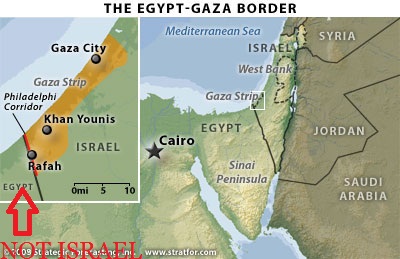
Granted, tourism to Palestine still faces many challenges, not least theIsraeli border authorities who control all routes into the West Bankand Gaza.
All routes? Really?

Ooops!  It seems like our former International Solidarity Activist volunteer forgot one quite large country.
Interestingly, a few days after her Guardian piece Irving retweeted the following:
#BREAKING: Rafa borders Egypt!

Austerity for Europe – increased EU aid for the Palestinians

The EU is set to blunder into a new funding fiasco for the Palestinians. Why should the European taxpayer be asked to throw yet more money at a hopeless cause?
Al-Aqsa Mosque
Al-Aqsa Mosque
Emanuele Ottolenghi Jonathan Schanzer

Written by Emanuele Ottolenghi and Jonathan Schanzer

on 27 November 2011 at 9am
1 2 3 4 5
total rating of 5.00
Sponsored Message:We Are Britain
Amidst Europe’s worst economic crisis in recent memory, the European Parliament (EP) has just decided to raise Europe’s aid to the Palestinians by €100 million - 30 percent more than previous years.
At the end of tough negotiations among the European Union’s institutions over the 2012 budget, the EP somehow made room for an additional €18 billion over the €129 billion cap imposed by expenditures-wary EU member states.  Among the additional line items is that extra €100 million for the Palestinians.
An extra €100 million may not seem like that much compared to an overall budget of €147 billion for 2012, but it cannot be ignored that this is money the EU does not have. Moreover, the EU is pledging taxpayer money at a time when the only guarantee it will be spent responsibly has just disappeared.
The EU budget decision was sealed just days before a highly anticipated summit between Palestinian Authority presidentMahmoud Abbas and Khaled Meshal of Hamas – a designated terrorist group in the EU. The two factions have been in a state of a low-level civil war since 2007, but agreed on Thursday to set a date for elections that would begin to end their feud.
According to reports in the Palestinian press, the two Palestinian rivals have not yet decided on their choice for the new premier. But their four likely choices look poor, ranging from Hamas loyalist Jamal al-Khodary to Mohammed Mustafa, the economic advisor to Mahmoud Abbas who has played a leading role in the creation of the ossified Palestinian political system.
No matter who is named, it will mean the end of Salam Fayyad – the moderate Palestinian Prime minister and former World Bank official who, thanks to his views, credentials and sound management, temporarily restored credibility, transparency and due diligence to Palestinian governance.
In other words, the EU investment is likely to backfire, and not for the first time.
The EU has been a financial backer of the Palestinian cause since 1971, when its institutional predecessor, the European Community, started funding The United Nations Relief and Works Agency (UNRWA), the UN agency in charge of underwriting Palestinian refugees and their descendants.
UNRWA is a bottomless pit of international aid – designed to keep Palestinian refugees in limbo, rather than resettling them, as the UN has done for every other displaced population in history. UNRWA is a waste of money by definition, even under the most stringent accountancy standards, since its raison d’être is to perpetuate the Palestinian refugee problem instead of solving it.
EU support dramatically increased in 1994, when the signing of the Oslo Accords seemed to offer a promise of Palestinian-Israeli peace, with huge sums ploughed into Palestinian state-building. From its outset, the Palestinian Authority was rife with corruption and wastefulness, but the wastefulness never drove off donors.
From 1994 to 2009, the EU donated €4.26 billion to the Palestinian Authority through various channels – and this figure does not take into account individual EU member states’ donations to the PA.
A 2005 investigation launched by OLAF, the EU anti-fraud office, into allegations of misuse of funding by the PA to support terrorist activities found “no conclusive evidence of support of armed attacks or unlawful activities financed by the European Commission’s contributions to the budget. However, the possibility of misuse of the Palestinian Authority’s budget and other resources cannot be excluded, due to the fact that the internal and external audit capacity in the Palestinian Authority is still underdeveloped.”
Rather than suspending its financial support, the EU responded by continuing to contribute substantial sums to the PA budget, even after Hamas – the Palestinian branch of the Muslim Brotherhood known best for its suicide attacks and other violent acts against civilians – won the 2006 Palestinian parliamentary elections and briefly took over the PA government before the 2007 Palestinian civil war left Hamas in control of Gaza while PA President Mahmoud Abbas clung to power in the West Bank.
This time, at least, the EU made an effort to improve Palestinian governance, and began to exact more stringent conditions and guarantees for the use of EU funds. It also established an institution now based in Ramallah (EUPOLCOPPS) that, among other things, helps training law enforcement agencies’ personnel in anti-corruption practices.
In recent years, despite the fractured Palestinian political landscape, the first and last line of defence for Palestinian financial transparency has been Prime Minister Fayyad.  
If Fayyad stays on as finance minister, he will no doubt attempt to enforce the practices of good governance and transparency that has earned him accolades in the West. However, there is no avoiding the fact that a unity government will represent an unpalatable marriage between Hamas and its jihadi ideology, and Fatah, replete with corrupt autocrats who have squandered international donor funds for years.
In a year of austerity, when European citizens must make additional sacrifices to avoid bankruptcy caused by reckless spending, opaque accounting practices and corrupt wastefulness, it is not too much to ask that public monies be pledged only against guarantees of nonviolence and good governance.
The coming Palestinian unity government promises to fall short on both counts. Why should Europe’s tax payers increase their pledge?
Emanuele Ottolenghi is a Senior Fellow at the Foundation for Defense of Democracies (FDD); Jonathan Schanzer is the Vice President for Research at FDD